


“What does YW mean?” In most texts and online conversations, YW means “you’re welcome.”
You’ve probably seen it pop up after someone says “thanks” and wondered if there’s more to it. Sometimes there is.
Context, tone, and even capitalization can shift its meaning in subtle ways. Let’s break it down clearly so you never misread it again.
YW Meaning | The Core Definition in Texting Slang
At its heart, YW is an abbreviation used in texting slang and internet slang. It stands for “You’re welcome.”
People use it as a quick response message in a conversational exchange after someone expresses gratitude.
Example:
- Person A: TY!
- Person B: YW 😊
That’s it. Simple. Efficient. Polite.
Why People Use YW Instead of “You’re Welcome”
Digital communication moves fast. Typing full phrases feels unnecessary when shorthand works just as well.
Here’s why YW dominates:
- Faster typing on mobile keyboards
- Casual tone in informal communication
- Character-saving in comment sections
- Habit from early SMS culture
- Common pattern in online conversation language
When you think about it, “you’re welcome” has 13 characters including the apostrophe and space. YW has two. That efficiency matters in high-speed chats.
YW as an Abbreviation vs Acronym
You’ll often see people call YW an acronym. Technically, it’s an abbreviation.
Here’s the difference:
| Term | Definition | Does YW Qualify? |
| Abbreviation | Shortened form of a phrase | Yes |
| Acronym | Pronounced as a word (e.g., NASA) | No |
| Initialism | Letters pronounced separately | Yes |
So YW functions as an initialism in digital communication. You say the letters: “Y-W.” You don’t pronounce it as a word.
That small distinction may seem trivial, yet it matters in linguistic accuracy.
YW Meaning in Text | Tone and Contextual Meaning
Words carry tone. So do abbreviations.
Although YW usually means “you’re welcome,” the contextual meaning depends on tone, timing, and the relationship between speakers.
Neutral Tone
- Direct.
- Polite.
- Efficient.
Example:
“Thanks for sending the file.”
“YW.”
Warm Tone
Add an emoji or punctuation:
- YW 😊
- yw!!
- Yw ❤️
The lowercase version often feels softer.
Downplay Expression
Sometimes YW minimizes effort.
Example:
“You saved my entire project!”
“YW, it was nothing.”
Here, it works as a subtle downplay expression.
Capitalization Variation | YW vs yw
Capitalization changes perception.
| Format | Perceived Tone | Usage Context |
| YW | Neutral or firm | Quick reply |
| yw | Casual, softer | Close friends |
| YW! | Slightly enthusiastic | Friendly |
| YW. | Can feel blunt | Neutral |
In social media language, lowercase letters often feel relaxed. Uppercase can look sharper or more transactional.
ALL CAPS? That can look intense.
“YW.”
Feels neutral.
“YW!!!”
Feels excited.
“YW”
Feels direct.
Tiny differences. Big perception shifts.
Conversational Intent Behind YW
Language is about intent. Even shorthand.
YW serves several conversational intents:
- Polite acknowledgment
- Closure of exchange
- Quick reply in fast chat
- Reciprocal shorthand
- Emotional moderation
It often mirrors the structure of the original message.
Mirrored Response Pattern
Notice how shorthand reflects shorthand:
- TY → YW
- THX → YW
- TYSM → YW
That’s a mirrored response dynamic. Digital speech compresses both gratitude and acknowledgment.
Alternate Meanings of YW | Semantic Variation Explained
Now things get interesting.
Although “you’re welcome” dominates, YW carries polysemy, meaning it has multiple possible meanings depending on context.
Let’s examine the real alternate meanings.
Yeah, Whatever
In some cases, YW stands for “Yeah, Whatever.”
Tone shifts dramatically here.
Example:
“You totally forgot to invite me.”
“YW.”
That reply could signal irritation. Sarcasm. Dismissiveness.
This usage falls under semantic variation in informal digital communication.
Clues that indicate this meaning:
- Argument context
- Previous tension
- Lack of emojis
- Short abrupt replies
Context decides everything.
Yes, Way
You’ve heard “No way.” The playful opposite? Yes, way.
Sometimes people shorten it to YW.
Example:
“There’s no way you won tickets.”
“YW!”
It’s rare compared to the primary meaning, yet it exists in playful chat circles.
Yo, Wassup
This usage appears in extremely casual slang environments.
Example:
“YW bro?”
Meaning: “Yo, what’s up?”
It’s uncommon. Most people interpret YW as “you’re welcome” first. Still, in specific communities, this interpretation pops up.
YW Meaning in Social Media Language
Usage shifts slightly across platforms.
On Instagram, YW often appears in comment threads.
- Influencer: “Thanks for all the support!”
- Follower: “YW!”
Short. Supportive. Public.
TikTok
On TikTok, speed dominates. Comment sections move quickly. YW thrives because it’s efficient.
Snapchat
On Snapchat, conversation feels closer and more private. Lowercase “yw” feels more common.
Each digital platform shapes tone subtly:
- Public comments lean neutral.
- Private chats lean casual.
- Creator-fan exchanges lean supportive.
Domain-Specific Meaning | Yearling Weight
Outside slang, YW has a technical meaning: Yearling Weight.
This term appears in the cattle community and livestock industries.
What Is Yearling Weight?
Yearling Weight (YW) measures a calf’s weight at approximately 365 days old.
It’s critical for:
- Breeding selection
- Genetic evaluation
- Performance tracking
- Market valuation
Measurement Units
- Pounds (lb)
- Kilograms (kg)
Related Terms
- Calf
- Weaning
- Yearling
- Livestock weight measurement
Farmers use YW in breeding records and auction catalogs.
Example Table:
| Animal ID | Birth Weight | Weaning Weight | Yearling Weight (YW) |
| A102 | 75 lb | 550 lb | 980 lb |
| B214 | 80 lb | 600 lb | 1,050 lb |
In this context, YW has nothing to do with texting slang. It’s purely a domain-specific abbreviation.
Religious Context | Young Women (LDS Organization)
YW can also refer to Young Women, a youth organization within The Church of Jesus Christ of Latter-day Saints.
This group focuses on:
- Faith development
- Leadership training
- Community service
- Spiritual growth
In religious conversations, YW refers to this organization. It’s not slang.
Again, context drives interpretation.
Is YW Rude?
Not inherently.
However, tone matters.
It Can Feel Rude When:
- Used after conflict
- Sent alone without punctuation
- Delivered with visible tension
- Appears dismissive
Compare:
“Thanks for helping.”
“YW 😊”
Versus:
“I guess you’re right.”
“YW.”
That second exchange can feel sharp.
Short replies after tension often signal sarcasm even if the letters mean “you’re welcome.”
How to Reply to YW
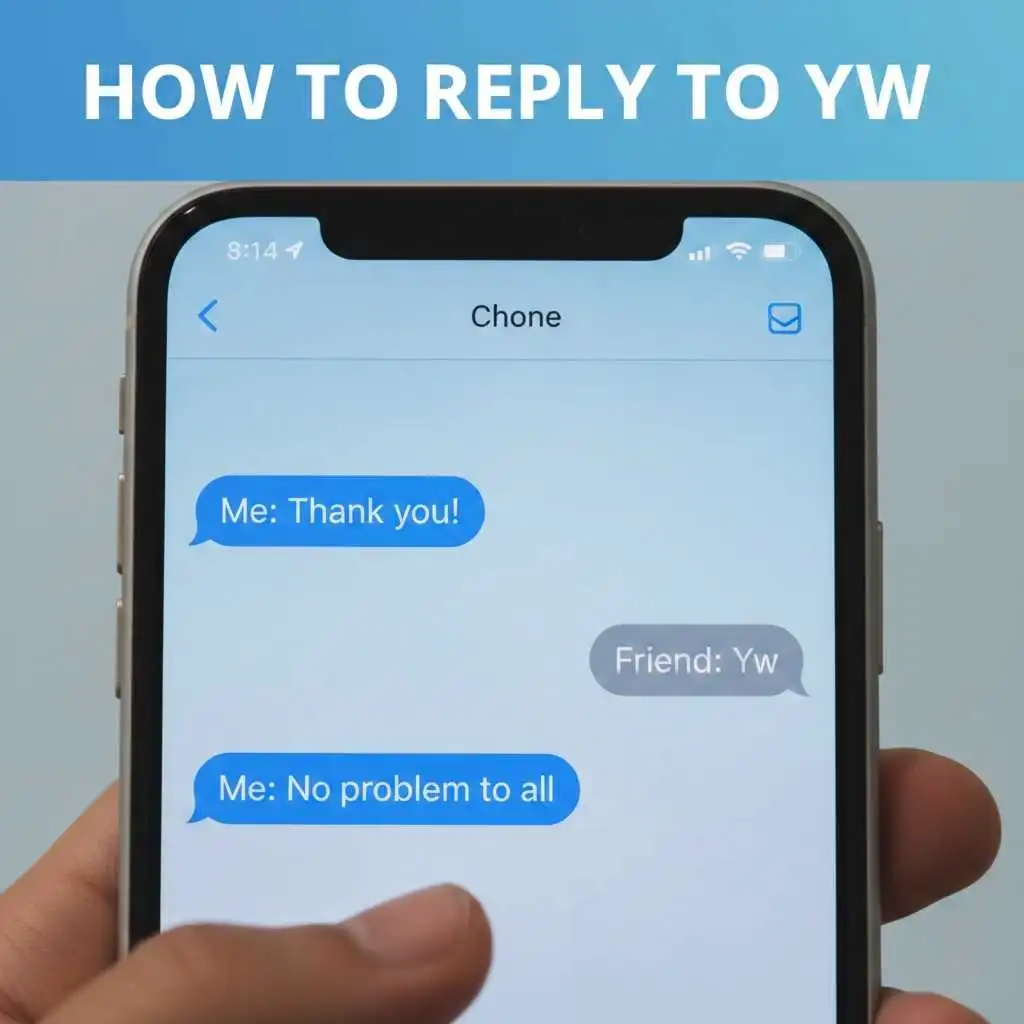
Usually, the conversation ends there.
But sometimes you want to continue.
Here are natural replies:
- Anytime!
- Of course.
- No problem at all.
- Happy to help.
- Let me know if you need anything else.
If someone says YW sarcastically, you can steer tone by adding warmth:
- I appreciate it.
- Seriously, thank you.
Related Slang and Text Message Abbreviations
Understanding YW helps you decode other chat abbreviations.
Common Gratitude Chain
- TY – Thank You
- TYSM – Thank You So Much
- THX – Thanks
- TIA – Thanks In Advance
Common Reaction Slang
- LMAO
- LOL
- BRB
- IDK
- No way
Together, they form a compressed online conversation language system.
It’s fast. Efficient. Context-dependent.
YW in Professional Settings

Should you use YW at work?
It depends.
Acceptable:
- Internal chat platforms
- Casual team conversations
- Startup culture environments
Avoid:
- Formal emails
- Client proposals
- Official documents
In professional writing, full phrases still carry authority.
“YW” works in Slack. Not in legal contracts.
Emoji Usage with YW
Emojis dramatically shift tone.
| Example | Interpretation |
| YW 😊 | Warm, friendly |
| YW 👍 | Confident |
| YW 🙌 | Celebratory |
| YW 😒 | Possibly sarcastic |
In modern emoji communication, tone often depends more on symbols than letters.
Why Abbreviations Like YW Dominate Digital Communication
Language adapts.
Mobile devices, social platforms, and constant messaging reshape how people write.
Here’s why shorthand thrives:
- Faster cognitive processing
- Reduced typing friction
- Cultural trend toward brevity
- Gen Z slang acceleration
- High-volume messaging environments
The brain recognizes patterns quickly. Two-letter responses reduce friction in conversation.
Psychological Impact of Short Responses
Short responses feel efficient. They can also feel distant.
Longer responses signal engagement. Short ones signal closure.
YW often acts as a conversational full stop.
Understanding that dynamic helps you avoid misreading tone.
Frequently Asked Questions About YW Meaning
What does YW mean in text?
It means “you’re welcome” in most cases.
What does YW mean on social media?
Usually “you’re welcome,” though tone varies based on capitalization and emoji usage.
Can YW mean something else?
Yes. It can mean “Yeah, Whatever,” “Yes, Way,” “Yearling Weight,” or “Young Women” depending on context.
Is lowercase yw different from uppercase YW?
Lowercase feels softer. Uppercase feels firmer.
Is YW formal?
No. It belongs to informal digital communication.
Quick Reference Summary Table
| Context | Meaning | Field |
| Texting | You’re welcome | Slang |
| Argument | Yeah, Whatever | Sarcasm |
| Playful chat | Yes, Way | Casual slang |
| Livestock | Yearling Weight | Agriculture |
| LDS | Young Women | Religious organization |
The Real Meaning of YW
In everyday use, YW means “you’re welcome.” It’s a compact form of polite acknowledgment in texting slang. However, semantic variation allows alternate meanings in specific communities. Tone depends on context, capitalization variation, emoji usage, and conversational intent.
When in doubt, read the full exchange. Context reveals meaning.
Conclusion
YW may look tiny yet it carries layered meaning. Most of the time it simply means you’re welcome. Still, tone, platform, and community shift interpretation in subtle ways.
Read context carefully before assuming sarcasm. Once you understand its variations, you’ll never misread it again.
Discover More:
- What Does ENM Mean? The Complete Guide to Ethical Non-Monogamy, ENM Relationships and Modern Love
- What Does Pushin P Mean? The Real Meaning, Origin and Viral Rise of Pushin P
- What Does Huzz Mean in Slang? The Real Meaning, Origin and Cultural Impact of This Gen Alpha Word

Tyler Wells is an American author known for his captivating storytelling and thoughtful insights into modern life. With a natural talent for weaving words into meaningful narratives, he has built a strong connection with readers who appreciate both authenticity and imagination.
Over the years, Tyler has written several acclaimed books, including “Echoes of the Dawn” (a moving story about hope and new beginnings), “Whispers Between the Lines” (a heartfelt story exploring love, loss, and resilience), and “The Silent Hour” (a suspenseful drama that keeps readers turning pages late into the night). His works blend emotional depth with relatable characters, making them both timeless and relevant for today’s audience.
Beyond writing, Tyler enjoys sharing his thoughts on creativity, personal growth, and the human experience. Whether through his books or his articles, he inspires readers to look at life from new perspectives and embrace their own stories with courage.