

“What does STFU mean?” You’ve probably seen it in texts, gaming chats, or social media comments.
It appears suddenly, often carrying strong emotion or sharp humor. Sometimes it’s playful, other times it feels aggressive.
Understanding its meaning, tone, and context helps you avoid misunderstandings and communicate smarter online.
This guide explains the STFU meaning, full form, origin, tone, variations, and real chat examples, so you’ll know exactly what it means and when people use it.
STFU Meaning | Simple Definition and Full Form
STFU means “Shut the f* up.”** It is a bold internet slang acronym used to tell someone to stop talking. People use it in text messaging, social media, gaming chats, and online conversations.
It belongs to a category called profanity abbreviation, where offensive words get shortened into acronyms.
Simple definition:
STFU is a texting abbreviation used to tell someone to be quiet, often expressing annoyance, disbelief, or humor.
The meaning depends heavily on tone and situation. The same acronym can sound playful or extremely rude depending on how someone uses it.
Key facts about STFU:
- It is an internet slang term
- It is a chat acronym
- It contains masked profanity
- It is used in informal communication
- It is common in digital communication culture
STFU Full Form Explained Clearly
The STFU full form is straightforward. Each letter represents the first letter of each word.
| Letter | Full Word |
| S | Shut |
| T | The |
| F | F*** |
| U | Up |
This structure makes STFU an acronym and shorthand abbreviation.
The word “f***” is often censored using asterisks. This is called profanity masking, which softens the visual impact of offensive language while preserving its meaning.
Why people shorten it:
- Faster typing
- Emotional emphasis
- Fits texting culture
- Saves time in chat
- Common in internet slang vocabulary
Instead of typing four words, users type just four letters.
What Does STFU Mean in Texting and Online Chat?
In text messaging slang, STFU works as a command phrase. It tells someone to stop speaking immediately.
However, tone determines whether it feels aggressive, funny, or sarcastic.
Common places where STFU appears:
- WhatsApp chats
- Snapchat messages
- Instagram comments
- Discord servers
- Gaming chat rooms
- Facebook Messenger
- TikTok comments
Meaning based on context:
| Situation | Meaning | Emotional Tone |
| Argument | Stop talking now | Aggressive |
| Joke | No way, unbelievable | Playful |
| Gaming | Express frustration | Competitive |
| Casual chat | Friendly teasing | Light humor |
For example:
Example 1 — Argument
User1: You never listen
User2: STFU
Meaning: aggressive command to stop talking.
Example 2 — Friendly disbelief
User1: I met my favorite celebrity
User2: STFU seriously?!
Meaning: shocked excitement, not aggression.
Is STFU Always Rude? Tone and Intent Explained
Tone determines everything. The same acronym can feel harmless or deeply offensive.
STFU generally falls into three tone categories.
Aggressive tone
This is the original meaning. It is a direct and hostile command.
People use it when they feel:
- Angry
- Frustrated
- Annoyed
- Disrespected
Example:
“STFU you don’t know anything”
This is clearly hostile.
Playful tone
Friends often use STFU jokingly.
It expresses surprise or excitement rather than anger.
Example:
“STFU you won the lottery?!”
This shows disbelief and excitement.
Sarcastic tone
Sometimes people use STFU sarcastically to mock or tease.
Example:
“Oh wow, you woke up early. STFU that’s impossible.”
Sarcasm changes the emotional meaning completely.
Real Chat Examples Showing STFU Usage
Understanding real examples helps you recognize tone and intent.
Angry example
User1: You always blame others
User2: STFU
Meaning: clear aggression.
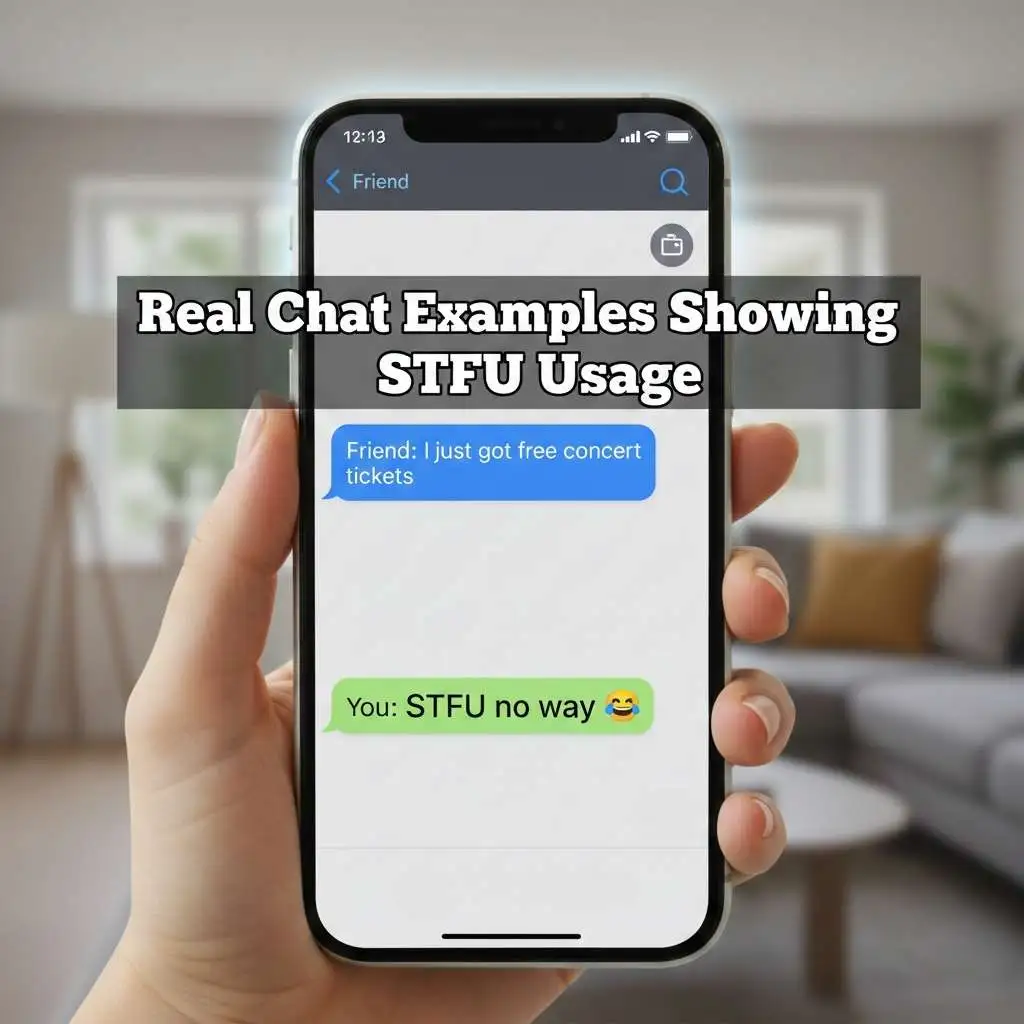
Funny example
User1: I just got free concert tickets
User2: STFU no way 😂
Meaning: shocked excitement.
Gaming example
Player1: You missed again
Player2: STFU bro
Meaning: frustration mixed with friendly competition.
Friendly teasing example
Friend1: I ate the entire pizza
Friend2: STFU you’re lying
Meaning: playful disbelief.
STFU Meaning on Social Media Platforms
Each platform shapes how people use internet slang.
Instagram usage
STFU appears in comments expressing surprise or disagreement.
Example:
“STFU that outfit looks amazing”
Positive disbelief.
TikTok usage
TikTok users use STFU in reactions to shocking videos.
Example:
“STFU that plot twist was wild”
This expresses excitement.
Snapchat usage
Snapchat conversations often use STFU casually between friends.
Tone is usually playful.
Discord and gaming usage
Gaming communities use STFU frequently.
It expresses:
- Frustration
- Competition
- Trash talk
Gaming culture normalizes aggressive slang.
Twitter/X usage
Arguments and debates make STFU common.
Users use it to silence opponents.
STFU vs Shut Up | Important Differences
Both phrases mean the same thing but carry different emotional weight.
| Phrase | Type | Emotional Strength |
| Shut up | Regular phrase | Moderate |
| STFU | Slang acronym | Strong |
STFU feels stronger because it includes profanity.
Why STFU feels more intense:
- Includes profanity
- Looks abrupt
- Common in arguments
- Feels emotionally charged
Variations and Related Slang Acronyms
Internet slang evolves constantly. Many variations of STFU exist.
SDFU Meaning
SDFU means “Shut da f* up.”**
It uses informal spelling.
Tone: aggressive or humorous.
STFUP Meaning
STFUP means “Shut the f* up please.”**
Adding “please” makes it slightly softer, but it still sounds aggressive.
STHU Meaning
STHU means “Shut the h* up.”**
This version replaces profanity with milder language.
Tone: less offensive.
SYFM Meaning
SYFM means “Shut your f**** mouth.”**
This is extremely aggressive.
Often used in heated arguments.
SU Meaning
SU simply means “Shut up.”
It is less aggressive than STFU.
Shh Meaning in chat
Shh means be quiet.
Tone: gentle or friendly.
Comparison table of variations:
| Acronym | Full Meaning | Aggression Level |
| STFU | Shut the f*** up | High |
| SDFU | Shut da f*** up | High |
| STFUP | Shut the f*** up please | Medium |
| STHU | Shut the h*** up | Medium |
| SU | Shut up | Low |
| Shh | Be quiet | Very low |
When Should You Use STFU (And When to Avoid It)
Using STFU in the wrong situation can damage relationships.
Appropriate situations
Use STFU only when:
- Talking to close friends jokingly
- Casual gaming chats
- Friendly teasing situations
- Informal online conversations
Situations to avoid completely
Never use STFU in:
- Professional environments
- Workplace chats
- Email communication
- Talking to strangers
- Customer service conversations
Using STFU professionally appears disrespectful.
Is STFU Offensive or Inappropriate?
Yes, STFU is considered offensive in many contexts.
Reasons:
- Contains profanity
- Sounds aggressive
- Commands someone to stop talking
- Shows disrespect if used seriously
However, among friends, it can feel harmless.
Context determines whether it offends someone.
Who Uses STFU Most Frequently?
Certain groups use internet slang more often.
Most common users:
- Teenagers
- Young adults
- Gamers
- Social media users
- Online communities
Why younger people use it more:
- Faster communication style
- Familiar with slang culture
- More exposure to digital communication
Older generations use it less often.
Origin and History of STFU
STFU emerged during early internet chat culture.
Timeline:
| Period | Development |
| 1990s | Early chatroom slang |
| 2000s | SMS texting popularized acronyms |
| 2010s | Social media spread usage globally |
| 2020s | Gaming and meme culture normalized it |
Text messaging limitations encouraged abbreviations.
People shortened phrases to save time and space.
Why People Use STFU Instead of Full Words
Human psychology favors efficiency.
Typing fewer characters saves time.
Main reasons people use STFU:
- Speed
- Convenience
- Emotional intensity
- Internet culture influence
- Habit formation
Short acronyms communicate emotion instantly.
STFU Meaning in Gaming Culture
Gaming communities heavily use chat acronyms.
STFU appears frequently in competitive environments.
Gaming situations where STFU appears:
- Losing frustration
- Trash talking opponents
- Teasing teammates
- Emotional reactions
Gaming culture normalizes aggressive slang more than other environments.
STFU Meaning from Linguistic and NLP Perspective
From a linguistic standpoint, STFU is classified as:
- Acronym
- Abbreviation
- Directive speech act
- Informal language
- Command phrase
A directive speech act attempts to control another person’s behavior.
STFU fits this definition perfectly.
Linguistic classification table:
| Category | Explanation |
| Acronym | Uses first letters |
| Shorthand | Shortened phrase |
| Slang | Informal language |
| Directive | Commands behavior |
| Profanity masking | Uses censored words |
This classification helps analyze digital communication patterns.
Similar Internet Slang Acronyms You Should Know
Many acronyms appear alongside STFU.
Common chat acronyms:
| Acronym | Meaning |
| LOL | Laughing out loud |
| OMG | Oh my God |
| WTF | What the f*** |
| IDK | I don’t know |
| BRB | Be right back |
These acronyms improve communication efficiency.
How to Respond When Someone Says STFU
Your response should depend on tone.
If used jokingly:
Respond playfully.
Example:
“Haha make me”
If used aggressively:
Stay calm or ignore it.
Avoid escalating conflict.
If unsure about tone:
Ask for clarification.
Example:
“Are you joking?”
This prevents misunderstanding.
STFU Meaning in Different Contexts Summary Table
| Context | Meaning | Tone |
| Argument | Stop talking | Aggressive |
| Joke | Surprise reaction | Playful |
| Gaming | Frustration expression | Competitive |
| Friendship | Teasing | Friendly |
| Social media | Reaction slang | Variable |
Understanding context prevents confusion.
Psychological and Social Meaning of STFU
STFU reflects emotional expression efficiency.
People use it when emotions run high.
It communicates instantly without long explanation.
Emotional triggers behind STFU usage:
- Anger
- Shock
- Excitement
- Frustration
- Humor
This makes it a powerful communication shortcut.
Why STFU Became Popular Worldwide

Global internet access accelerated slang spread.
Social media platforms amplified usage.
Gaming culture reinforced aggressive slang normalization.
Factors behind popularity:
- Internet growth
- Mobile texting culture
- Meme culture
- Gaming communities
- Social media influence
STFU became part of modern digital language.
Key Facts Summary About STFU
- STFU means “Shut the f*** up”
- It is an internet slang acronym
- Used in texting and online chat
- Tone determines meaning
- Common in gaming and social media
- Can be offensive depending on context
Frequently Asked Questions
What does STFU stand for?
STFU stands for “Shut the f*** up.” It is a slang acronym used in texting and online chat.
Is STFU rude or offensive?
Yes, STFU can be rude because it contains profanity. However, friends sometimes use it jokingly.
What does STFU mean in texting?
In texting, STFU means telling someone to stop talking. Tone determines whether it sounds aggressive or playful.
Is STFU slang or an official word?
STFU is internet slang. It is not formal language.
Where is STFU used most often?
STFU appears most often in social media, gaming chats, texting, and informal online conversations.
Conclusion
STFU is a powerful internet slang acronym that means “Shut the f*** up.” Its meaning changes based on tone, context, and relationship between people. Friends often use it jokingly, while strangers may use it aggressively.
Understanding its usage helps you communicate better and avoid misunderstandings. Internet slang continues evolving, and STFU remains one of the most recognizable chat acronyms today.

Tyler Wells is an American author known for his captivating storytelling and thoughtful insights into modern life. With a natural talent for weaving words into meaningful narratives, he has built a strong connection with readers who appreciate both authenticity and imagination.
Over the years, Tyler has written several acclaimed books, including “Echoes of the Dawn” (a moving story about hope and new beginnings), “Whispers Between the Lines” (a heartfelt story exploring love, loss, and resilience), and “The Silent Hour” (a suspenseful drama that keeps readers turning pages late into the night). His works blend emotional depth with relatable characters, making them both timeless and relevant for today’s audience.
Beyond writing, Tyler enjoys sharing his thoughts on creativity, personal growth, and the human experience. Whether through his books or his articles, he inspires readers to look at life from new perspectives and embrace their own stories with courage.