

“What does SMS mean in texting?” You see “SMS” on your phone every day, yet most people don’t know what powers it behind the scenes.
SMS quietly delivers billions of messages across the globe without apps, Wi-Fi, or data plans. It feels simple on the surface.
Underneath, however, it runs on precise communication protocols and carrier infrastructure that have evolved for more than three decades.
Let’s break it down clearly, technically and practically.
What Does SMS Mean in Texting?
SMS stands for Short Message Service. It is a standardized text messaging service that allows mobile phones to exchange short, text-only messages over a mobile phone network.
When you send a basic text without images or internet, you’re using SMS messaging.
Here’s the simplest SMS definition:
SMS is a cellular-based messaging protocol that sends short text messages between devices without requiring internet access.
Key Characteristics of SMS
- Uses the SMS protocol
- Operates over Global System for Mobile Communications (GSM)
- Text-only format
- 160-character limit (standard encoding)
- Works on nearly every mobile phone
- Does not require Wi-Fi or mobile data
Many people use “text message” and “SMS” interchangeably. Technically, texting is the action. SMS is the technology.
The History of SMS | From Experiment to Global Standard
SMS didn’t appear overnight. It evolved from early mobile communication research in the 1980s.
The First SMS Ever Sent
On December 3, 1992, Neil Papworth sent the first SMS message. He worked for Sema Group. The message read:
“Merry Christmas”
It was sent to a Vodafone executive’s Orbitel 901 handset.
The idea itself began in 1985 during the standardization of Global System for Mobile Communications (GSM). Engineers designed SMS as a lightweight signaling feature, not as a primary communication method. Ironically, it became one of the most widely used communication tools in history.
SMS by the Numbers
- Over 23 billion messages sent daily worldwide
- Roughly 270,000 messages per second
- More than 5 billion mobile subscribers globally
- 32+ years of operational history
Despite messaging apps dominating headlines, SMS remains one of the most resilient technologies in telecom.
How SMS Works | The Technical Breakdown
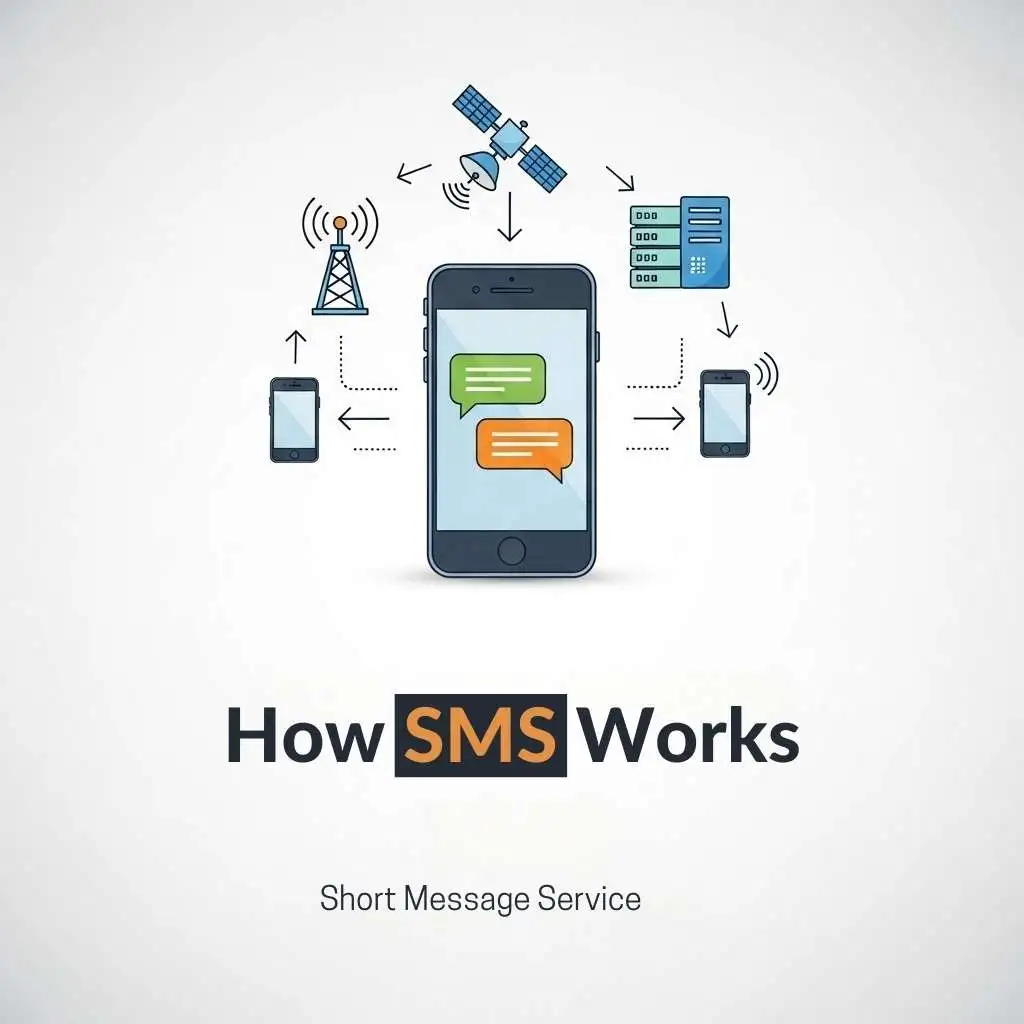
SMS might look simple. It isn’t. Behind every message lies a structured delivery process.
The SMS Protocol Explained
The SMS protocol operates within the GSM signaling channel, not the voice channel. That’s important.
Unlike voice calls, SMS uses a store-and-forward model. This means:
- The message gets stored at a central server.
- The network forwards it when the recipient becomes available.
This design ensures reliability even if the recipient’s phone is temporarily off.
Message Journey Diagram
Here’s how a typical SMS travels:
Your Phone
↓
Mobile Phone Tower
↓
Mobile Phone Carrier Network
↓
SMS Gateway
↓
Recipient Carrier
↓
Recipient Phone
Let’s break this down.
Mobile Phone Tower
Your device connects to the nearest tower. The signal enters your mobile phone carrier network.
SMS Gateway
The SMS gateway acts as a routing center. It determines where the message needs to go and forwards it to the destination carrier.
Data Routing
The network uses structured data routing methods to deliver messages quickly. High-performance systems handle:
- Throughput (events per second) exceeding 10,000
- Delivery success rates above 95%
- Most messages delivered within seconds
That’s serious engineering.
SMS Character Limits Explained
One of the most misunderstood aspects of SMS is its character limit.
GSM 7-Bit Default Alphabet
Standard SMS uses the GSM 7-bit character set.
- Maximum: 160 characters
- Includes standard Latin letters, numbers, and basic symbols
This encoding optimizes data efficiency. It compresses text tightly into network packets.
UTF-16 Encoding and the 70-Character Limit
When you use:
- Emojis
- Non-Latin characters
- Special symbols
Your phone switches to UTF-16 encoding.
Result?
- Maximum: 70 characters per message
That’s why adding a single emoji can dramatically reduce your available space.
Message Concatenation
What happens if you exceed limits?
The network splits the message into segments. This process is called concatenated SMS.
Example:
| Characters | Segments Sent |
| 160 | 1 |
| 161–306 | 2 |
| 307–459 | 3 |
Each segment includes metadata so the receiving device reassembles the message seamlessly.
SMS vs MMS | What’s the Difference?
Many users confuse SMS with Multimedia Messaging Service (MMS).
Here’s a clear comparison:
| Feature | SMS | MMS |
| Full Form | Short Message Service | Multimedia Messaging Service |
| Content Type | Text only | Images, video, audio |
| Character Limit | 160 (7-bit) | Much larger |
| Data Required | No | Usually yes |
| Cost | Lower | Higher |
MMS supports:
- Photos
- GIFs
- Audio clips
- Video content
However, MMS relies more heavily on mobile data infrastructure. SMS works even without an active data plan.
SMS vs RCS | The Evolution of Messaging
Rich Communication Services (RCS) aims to replace SMS with modern features.
What RCS Offers
- Read receipts
- Typing indicators
- High-resolution media
- Rich media
- Smart buttons
- Carousels
- Verified sender profiles
Unlike SMS, RCS requires internet access.
SMS Fallback
When RCS fails due to connectivity issues, your phone activates SMS fallback. This ensures delivery continuity.
Apple introduced broader RCS support in 2025, significantly changing messaging interoperability between Android and iPhone.
Still, SMS remains the universal backup.
SMS vs Messaging Apps
Popular messaging apps include:
- WhatsApp
- Facebook Messenger
- iMessage
- Telegram
Here’s how SMS compares:
| Feature | SMS | Messaging Apps |
| Internet Required | No | Yes |
| End-to-End Encryption | No | Yes (most) |
| App Install Needed | No | Yes |
| Cross-Device Sync | Limited | Strong |
| Global Compatibility | Universal | App-dependent |
Messaging apps rely on Wi-Fi messaging or mobile data messaging. SMS uses cellular signaling.
If you lose internet access, apps fail. SMS keeps working.
Is SMS Secure?
Security often raises concern.
Encryption Reality
SMS does not use end-to-end encryption. Messages are encrypted between your phone and the carrier tower but not throughout the entire route.
That means:
- Carriers can access message content
- Interception risks exist
- It’s less secure than encrypted messaging apps
Why SMS Is Still Used for Two-Factor Authentication
Despite limitations, SMS powers:
- Two-Factor Authentication (2FA)
- One-Time Passwords (OTP)
- Identity verification systems
Banks, social media platforms, and enterprise services use SMS because:
- It works on any device
- It doesn’t require apps
- It has near-universal reach
However, SIM-swapping attacks highlight potential vulnerabilities.
Business SMS and Bulk Messaging
SMS isn’t just personal. It’s a massive customer messaging channel.
What Is Bulk SMS?
Bulk SMS allows businesses to send thousands or millions of messages simultaneously.
Use cases:
- Appointment reminders
- Delivery updates
- Marketing campaigns
- Alerts and notifications
SMS Gateway and Providers
An SMS provider offers infrastructure that connects businesses to carrier networks.
Key performance metrics:
- Throughput capacity
- Message delivery rate
- Compliance regulations
- Spam filtering
Modern messaging platforms also include:
- Click tracking
- Performance analytics
- Campaign segmentation
- Automation workflows
SMS open rates often exceed 90%. Most messages get read within three minutes.
Advanced SMS Applications
SMS supports more than conversations.
Emergency Systems
Advanced Mobile Location (AML) enhances emergency response accuracy by transmitting precise GPS data during emergency calls.
Governments use SMS for:
- Disaster alerts
- Weather warnings
- Public safety announcements
Because SMS doesn’t require internet, it remains critical in crisis situations.
Why SMS Is Still Relevant Today
People ask, “Is SMS still relevant?”
Absolutely.
Here’s why:
- Works without internet
- Universal device compatibility
- Reliable delivery
- Supports 2FA and OTP
- Essential fallback system
- Global infrastructure already built
Even as next-generation messaging evolves, SMS remains foundational.
Frequently Asked Questions
What does SMS mean in texting?
It means Short Message Service, a cellular-based text messaging protocol.
Is SMS the same as a text message?
Technically no. SMS is the technology. Texting is the action.
Does SMS use Wi-Fi?
No. It uses cellular signaling channels.
What happens if I exceed 160 characters?
The message splits into segments using concatenation.
Is SMS free?
It depends on your mobile plan. Many carriers include unlimited texting.
Can SMS be hacked?
It can be intercepted under certain conditions. It is not end-to-end encrypted.
The Future of SMS
SMS will not disappear overnight. Instead, it will coexist with RCS and messaging apps.
Expect:
- Continued use in authentication
- Strong presence in enterprise communication
- Ongoing SMS fallback functionality
- Integration with business messaging ecosystems
SMS may look old. But it remains indispensable.
Conclusion
SMS stands for Short Message Service, and it remains one of the most reliable communication systems ever built. It works without internet, reaches nearly every mobile device, and powers everything from casual texts to global authentication systems.
While newer technologies like RCS add features, SMS continues to serve as the universal fallback. Understanding how SMS works helps you appreciate the invisible infrastructure behind every text you send.

Edward Grant is an American author known for his modern storytelling and thought-provoking narratives. With a passion for exploring human emotions, relationships, and the complexities of everyday life, Edward writes in a style that feels both relatable and inspiring. His journey as a writer began in his early 20s, fueled by a love for literature and a deep curiosity about the world around him.
Over the years, Edward has developed a reputation for crafting characters that feel real, layered, and unforgettable. Whether he’s writing contemporary fiction or reflective essays, his work resonates with readers who value authenticity and emotional depth. Beyond writing, Edward is also an avid reader and enjoys spending time in quiet libraries and creative workspaces where new ideas come to life.
Some of his notable works include Whispers of Tomorrow, Shadows of the Heart, and The Last Horizon, each of which has received appreciation for its unique voice and meaningful storytelling.