


“What does PRN mean?” You’ve likely seen it printed on a prescription bottle and wondered what it actually tells you to do.
PRN meaning often confuses patients especially after surgery or during injury recovery. In simple terms it means you take medication only when you need it. However there’s much more to understand if you want safe and effective results.
Let’s break it down clearly so you know exactly how PRN on prescription works and how to use it safely.
What Does PRN Mean in Medical Terms?

The term PRN comes from the Latin phrase pro re nata meaning “as needed.” Doctors use this medical abbreviation to indicate that you should take a medication only when specific symptoms appear.
Instead of following a fixed clock schedule you respond to symptoms.
That’s it at the core.
But context matters.
When a provider writes:
“Take 1 tablet every 6 hours PRN for pain.”
They mean:
- Take the medicine only if pain appears
- Wait at least 6 hours between doses
- Do not exceed the stated maximum dosage
PRN is part of standard medical abbreviations on prescriptions used worldwide. It helps keep instructions short while preserving clarity.
Why Doctors Use PRN
Doctors prescribe PRN medications because:
- Not all symptoms happen constantly
- Some pain fluctuates during recovery
- Taking medicine unnecessarily increases risk
- It reduces medication overuse
- It supports short-term medication use
PRN is about control. You stay responsive to symptoms instead of following a rigid routine.
What Does PRN Mean on a Prescription Bottle?
When you see PRN on prescription instructions, it typically appears after the dosing interval.
Example:
Take 1 tablet every 4–6 hours PRN for pain. Do not exceed 6 tablets in 24 hours.
Let’s decode this clearly.
| Instruction Element | What It Means | What You Should Do |
| Every 4–6 hours | Minimum time between doses | Wait at least 4 hours |
| PRN | As needed | Take only if symptoms appear |
| Maximum dosage | Daily safety limit | Never exceed in 24 hours |
Many people misunderstand PRN and think it means optional. It does not mean random.
It means symptom-triggered medication with limits.
What PRN Does NOT Mean
- It does not mean take anytime without tracking
- It does not override dosage instructions
- It does not allow doubling doses
- It does not replace your treatment plan
Always read the full prescription instructions carefully.
PRN vs Scheduled Medications | What’s the Difference?
Understanding PRN vs scheduled medications protects you from misuse.
Here’s the difference:
| Feature | PRN Medication | Scheduled Medication |
| Timing | As symptoms occur | Fixed schedule |
| Purpose | Symptom-based relief | Continuous control |
| Example | PRN pain medication | Blood pressure medicine |
| Flexibility | High | Low |
| Risk if missed | Usually minimal | Often serious |
PRN (As Needed Medication)
Used when symptoms are unpredictable:
- Pain
- Swelling
- Inflammation
- Temporary discomfort
Scheduled (Fixed Schedule Medication)
Used when constant levels are required:
- Blood pressure medications
- Diabetes medications
- Certain antibiotics
- Hormonal treatments
Around-the-clock medication maintains steady levels in your body. PRN medication reacts to symptoms.
Both approaches are valid. The doctor chooses based on your condition.
Why Doctors Prescribe PRN Medications
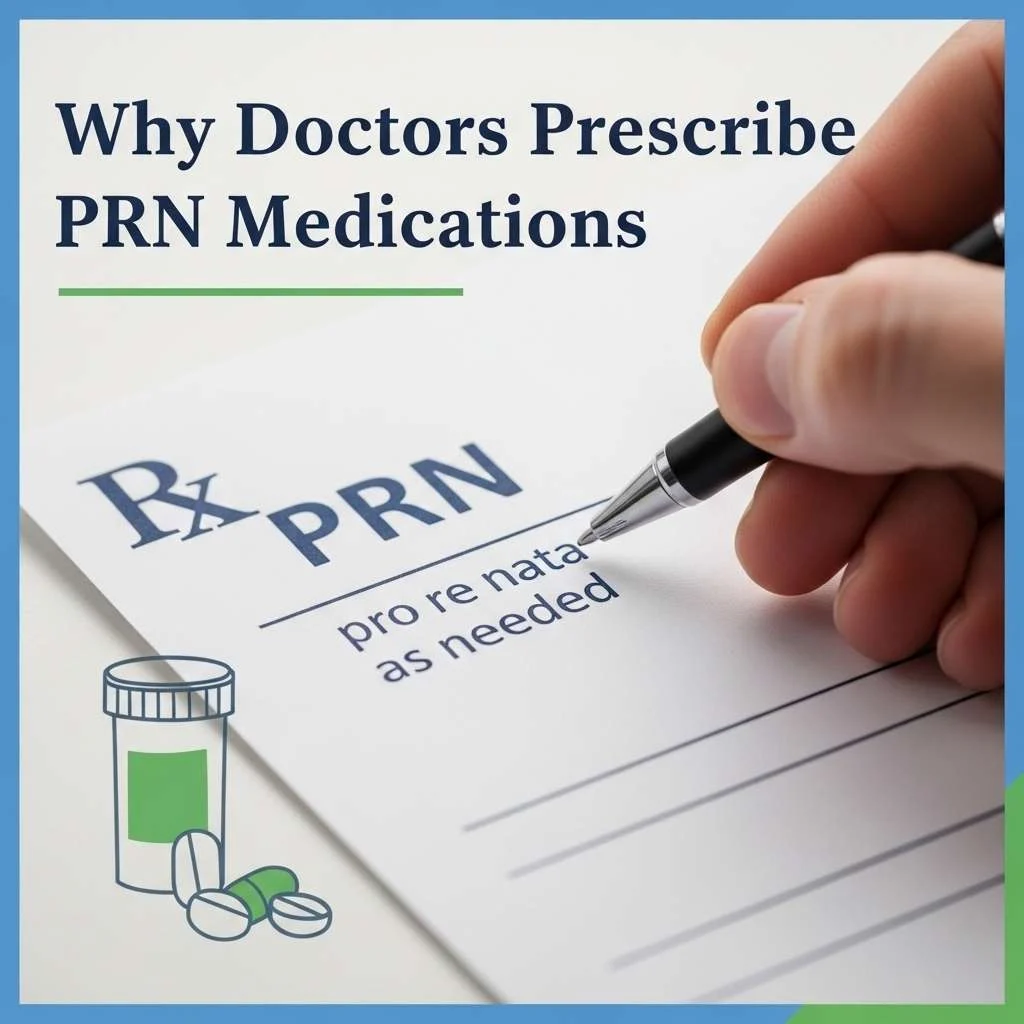
PRN prescriptions are common in:
- Post-surgery pain management
- Injury recovery
- Acute inflammation
- Migraine treatment
- Muscle spasms
In orthopedic care especially, pain levels fluctuate.
For example:
After an orthopedic procedure, pain may spike during movement but decrease while resting. Taking medication only during spikes reduces unnecessary exposure.
Benefits of PRN Prescriptions
- Reduces total drug intake
- Lowers risk of medication misuse
- Supports safe pain management
- Prevents unnecessary sedation
- Encourages patient awareness
PRN empowers patients while keeping safety boundaries.
PRN in Orthopedic Care and Injury Recovery
If you’ve seen an orthopedic doctor or orthopedic specialist, you’ve likely received a PRN prescription.
Why?
Because conditions such as:
- Joint pain
- Arthritis
- Tendonitis
- Musculoskeletal injury
- Post-surgical discomfort
do not always cause constant pain.
Example Scenario
After a minor knee procedure:
- Morning stiffness may require PRN medication
- Afternoon rest may require none
- Physical therapy session may trigger temporary pain
This approach fits perfectly into an orthopedic treatment plan.
Providers Who Commonly Prescribe PRN
- Board-certified orthopedic surgeons
- Fellowship-trained orthopedic specialists
- Pain management physicians
- Physician assistants
- Physical therapy providers
They design a treatment approach based on your recovery phase.
PRN medication often supports:
- Orthopedic injury recovery
- Swelling and inflammation relief
- Temporary nerve irritation
- Activity-related discomfort
Understanding PRN Dosage Instructions Clearly
Misreading PRN dosage instructions is one of the most common patient mistakes.
Let’s break it down.
Example Prescription
Take 1 tablet every 6 hours PRN for pain. Maximum 4 tablets daily.
This means:
- You can take up to 4 doses in 24 hours
- You must wait 6 hours between doses
- You only take it if pain exists
You do not take 4 automatically.
Safe PRN Checklist
Before taking your dose ask yourself:
- Do I actually feel symptoms?
- How severe is the pain?
- When was my last dose?
- Am I below the maximum dosage limit?
- Have I eaten if required?
Tracking doses matters.
Some patients use:
- Phone alarms
- Medication apps
- Written logs
- Pill organizers
Consistency prevents accidental overdose.
Safety Guidelines for PRN Medications
PRN prescriptions reduce risk but they do not eliminate it.
Watch for Side Effects
Common PRN medication side effects may include:
- Drowsiness
- Nausea
- Constipation
- Dizziness
If symptoms worsen contact your provider immediately.
Avoid Medication Overuse
Overusing PRN medication can lead to:
- Liver strain
- Kidney stress
- Dependence (with certain drugs)
- Masking serious symptoms
Pain that requires constant PRN dosing may indicate a deeper issue.
Activity Restrictions
Some PRN pain medications affect alertness.
Avoid:
- Driving
- Operating machinery
- Making major decisions
Follow label instructions carefully.
PRN After Surgery | What You Should Expect

After an orthopedic surgery, PRN pain medication plays a specific role.
Immediately post-surgery:
- Pain may require scheduled medication
- Later it transitions to PRN use
This shift indicates improvement.
Typical Post-Surgery Progression
| Recovery Stage | Medication Pattern |
| First 24–48 hours | Often scheduled |
| Days 3–7 | Combination |
| Week 2 onward | Mostly PRN |
If you still need frequent PRN dosing after weeks, consult your doctor.
It may require:
- Further evaluation
- Adjustment in treatment
- Imaging
- Physical therapy changes
PRN helps track recovery progress.
When to Contact Your Orthopedic Doctor
Do not rely solely on PRN medication if:
- Pain worsens unexpectedly
- Swelling increases
- Fever develops
- Medication provides no relief
- You experience severe side effects
Your orthopedic urgent care provider can reassess the situation.
Sometimes pain signals:
- Infection
- Improper healing
- Nerve compression
- Hardware complications
Medication should support recovery not hide complications.
PRN in Urgent Orthopedic Care Settings
In same-day orthopedic urgent care, providers often prescribe PRN medications because:
- Injuries vary in severity
- Symptoms change rapidly
- Recovery depends on movement
PRN fits well in urgent care where:
- No appointment required
- Short-term symptom relief matters
- Follow-up plans evolve quickly
Patient education becomes critical here.
Understanding PRN prescription instructions prevents unnecessary ER visits.
Common Conditions Treated With PRN Medications
PRN medications often address:
- Acute sprains
- Post-operative inflammation
- Muscle spasms
- Flare-ups of arthritis
- Tendon irritation
These are symptom-driven problems.
They don’t always require round-the-clock medication.
How PRN Supports Safe and Effective Recovery
PRN encourages body awareness.
Instead of taking medication automatically you evaluate symptoms.
That awareness:
- Reduces total drug exposure
- Encourages gradual improvement
- Builds confidence
- Prevents dependency
It supports smarter healing.
Key Takeaways About PRN Meaning
- PRN means as needed
- It stands for pro re nata
- It is a common medical abbreviation
- Always respect the maximum dosage
- Use only when symptoms appear
- Contact your doctor if pain persists
Understanding PRN on prescriptions protects your health.
Frequently Asked Questions
Does PRN mean optional?
No. PRN means take when symptoms occur within defined limits.
Can I take PRN medication daily?
Yes if symptoms require it and you stay within dosage limits. Persistent need requires medical review.
Is PRN safe for long-term use?
Some medications are safe short-term only. Long-term PRN use should be supervised.
What happens if I skip a PRN dose?
Nothing. You only take PRN medication when symptoms appear.
Can PRN medications cause dependency?
Certain PRN pain medications can. Always follow instructions strictly.
Conclusion
Understanding what does PRN mean removes confusion and improves safety. PRN meaning is simple on the surface yet powerful when applied correctly. It gives you control while maintaining medical boundaries.
When used responsibly PRN supports safe pain management and faster recovery. Always follow dosage instructions carefully and communicate with your healthcare provider if symptoms persist.

Ashton Cole is an American author celebrated for his compelling storytelling and ability to capture the depth of human emotions. His works often explore themes of love, resilience, and self-discovery, making him a relatable voice for readers around the world.
He has published several well-received books, including:
-
Whispers of Dawn – a reflective novel about finding hope in life’s darkest moments.
-
Beneath the Silent Sky – a moving story of love, memory, and the bonds that shape us.
-
The Edge of Forever – a thought-provoking tale that blends drama, destiny, and the courage to begin again.
Through his writing, Ashton strives to inspire readers to see beauty in both the struggles and triumphs of life. When he isn’t writing, he enjoys exploring new cities, collecting rare books, and spending time in cozy coffee shops where many of his story ideas take shape.