


“What does personification mean?” It means giving human qualities to a non-human entity or an abstract idea to create vivid, emotional, and memorable language.
You see it in poetry, novels, speeches, and even everyday conversation. When writers want to make readers feel something instead of just understand it, they often turn to personification.
Let’s break it down in depth so you can recognize it, analyze it, and use it with confidence.
What Does Personification Mean? The Clear Definition
At its core, personification is a literary device within figurative language. It assigns human attributes, emotions, intentions, or actions to something that isn’t human.
That “something” could be:
- Nature (wind, storm, sun, trees)
- Objects (blanket, train, wardrobe, candlestick)
- Animals
- Concepts (fear, love, death, time, hope)
- Settings (city, landscape, sky)
Here’s the simplest working definition:
Personification is the act of giving human traits to non-human entities for dramatic or descriptive effect.
Let’s examine this through a quick table.
| Non-Human Entity | Human Quality Assigned | Personified Sentence |
| Fear | Stalking | Fear stalked the village. |
| Sun | Smiling | The sun smiled down on us. |
| Wind | Whispering | The wind whispered through the trees. |
| Cold | Biting | The cold bit at her fingers. |
| Time | Crawling | Time crawled during the exam. |
Notice the pattern. Each subject performs a human action or expresses emotion. That’s the key signal.
Without personification, language can feel flat. With it, writing gains imagery, rhythm, and emotional charge.
How Personification Works in Figurative Language
To truly understand what personification means, you need to look at its mechanics. Writers assign one or more of these semantic features:
- Actions (stalked, whispered, screamed)
- Thoughts (the sky remembered)
- Feelings (the lonely road waited)
- Intentions (the storm attacked the coast)
Let’s compare literal and figurative description:
Literal:
The wind blew hard.
Personified:
The wind slapped the shutters in rage.
In the second sentence, the wind acts with intention. It becomes an emotional force rather than simple weather.
Common Structures of Personification
Writers often use:
- Verb-driven construction
The train groaned to a stop. - Emotional attribution
The gloomy sky refused to brighten. - Sensory exaggeration
The heat wrapped its arms around the city.
When you read closely, you’ll notice personification rarely appears randomly. It serves description, builds symbolism, or deepens narrative tone.
Personification vs Anthropomorphism | What’s the Real Difference?
People often confuse personification with anthropomorphism. They sound similar. They aren’t identical.
Personification
- Assigns brief human qualities
- Usually limited to one descriptive moment
- Common in poetry and descriptive prose
Example:
The trees danced in the wind.
The trees are not literally characters. They simply move like dancers.
Anthropomorphism
- Gives full human identity to non-human beings
- Includes speech, clothing, sustained personality
- Used in fiction, cartoons, and fables
Example:
A rabbit that talks, wears clothes, and makes decisions like a human.
Here’s a direct comparison:
| Feature | Personification | Anthropomorphism |
| Duration | Short descriptive moment | Full character identity |
| Human Behavior | Partial | Complete |
| Used For | Imagery, emotion | Storytelling with animal characters |
| Example | The storm raged | A talking storm character |
The difference lies in sustained characterization. Personification enhances a sentence. Anthropomorphism creates a character.
Personification vs Metaphor and Simile
Another common confusion involves metaphor and simile.
Metaphor
A direct comparison without “like” or “as.”
The classroom was a zoo.
Simile
Uses “like” or “as.”
The wind moved like a ghost.
Personification
Gives human traits.
The wind whispered secrets.
Now here’s where it gets interesting. Personification often overlaps with metaphor because it relies on metaphorical usage.
However:
- Simile construction signals comparison explicitly.
- Metaphor equates two unlike things.
- Personification assigns human traits specifically.
Think of it this way:
- All personification is figurative.
- Some personification involves metaphor.
- Not all metaphors involve personification.
Clear boundaries help with literary analysis.
Why Writers Use Personification

Why not just describe things literally? Because literal language informs. Personification transforms.
Writers use it to:
- Create vivid language
- Strengthen imagery in literature
- Increase emotional expression
- Add dramatic effect
- Improve audience engagement
- Make abstract ideas tangible
Consider this:
Plain:
Grief overwhelmed her.
Personified:
Grief wrapped its arms around her and refused to let go.
The second version feels physical. Immediate. Heavy.
Personification gives shape to invisible experiences. It turns emotion into something you can almost touch.
Personification in Poetry
Poetry thrives on compression and layered meaning. That’s why personification in poetry appears everywhere.
Nature often receives human traits:
- The setting sun waved goodbye.
- The sleeping fields dreamed under moonlight.
- Spring sunshine kissed the flowers awake.
- Gloom lingered at the doorway.
These lines don’t just describe scenery. They build atmosphere.
Why Poets Use It
- To intensify symbolism
- To enrich rhythm
- To deepen emotional resonance
- To condense complex ideas into short lines
When a poet writes, “Fear stalked the village,” fear becomes an intruder. A predator. A presence.
That’s far more powerful than saying people were afraid.
Personification in Prose | Fiction and Nonfiction
You might think personification in prose belongs only to novels. Not true.
It appears in:
- Fiction
- Memoir
- Narrative nonfiction
- Descriptive journalism
A city can refuse to sleep.
A landscape can stretch endlessly.
A wardrobe can stand in silent judgment.
Writers use this technique to establish tone quickly.
In Fiction
Personification often enhances mood:
- The sky darkened in anger.
- The house groaned at midnight.
In Nonfiction
Even factual writing uses subtle figurative expression:
- History remembers.
- The economy stumbled.
- The law demands justice.
These phrases animate abstract systems. They improve clarity and flow without sacrificing meaning.
Everyday Speech Examples of Personification
You probably use personification daily without realizing it.
Common phrases:
- Opportunity knocked.
- Time flies.
- The computer hates me.
- My alarm clock screamed.
- The blanket hugged me.
- The train crawled through traffic.
Notice how casual speech relies on figurative expression. Personification makes language lively. It prevents monotony.
Without it, conversation would feel robotic.
Deep Literary Examples of Personification
Writers across history use personification to heighten meaning.
In Heart of Darkness, the river seems to possess mood and presence. The landscape almost watches the characters.
In Beauty and the Beast, enchanted objects blur into anthropomorphism. Yet the castle itself often feels alive through personified description.
These examples show how personification supports narrative writing and emotional layering.
How to Identify Personification Instantly
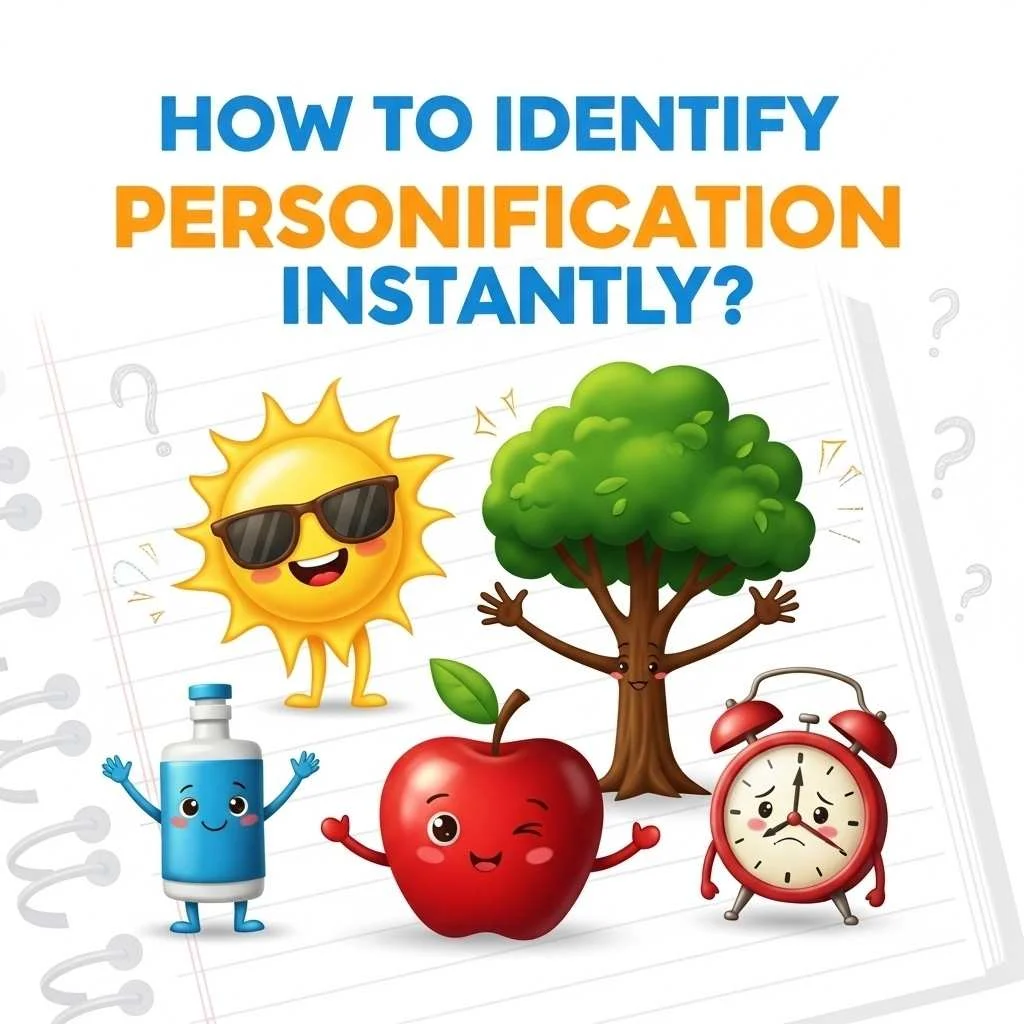
Spotting personification becomes easy once you train your eye.
Use this checklist:
- Is the subject non-human?
- Does it perform a human action?
- Does it express emotion?
- Does it show intention or thought?
If yes, you’re likely looking at personification.
Let’s test it:
The storm attacked the coastline.
- Storm = non-human
- Attacked = intentional human action
That’s personification.
How to Use Personification in Your Own Writing
Using personification effectively requires control. Too much feels dramatic. Too little feels dull.
Practical Tips
- Match tone to genre
- Avoid cliché phrases
- Use strong verbs
- Don’t overuse emotional exaggeration
- Blend into natural rhythm
Weak example:
The sun smiled brightly.
Stronger example:
The sun stretched lazily across the horizon.
The second uses physical imagery. It feels grounded.
Where It Works Best
- Describing weather
- Expressing internal emotion
- Establishing setting
- Reinforcing symbolism
Used wisely, personification enhances storytelling techniques without overwhelming readers.
Common Mistakes Writers Make
Even experienced writers stumble.
Confusing with Anthropomorphism
Giving animals full dialogue shifts categories.
Overloading Description
If every object sighs, groans, and whispers, readers lose impact.
Using Clichés
“The wind whispered” appears everywhere. Try fresher verbs.
Inconsistent Tone
Serious nonfiction rarely benefits from dramatic exaggeration.
Keep it intentional.
Emotional and Psychological Impact on Readers
Personification works because the human brain seeks agency.
We naturally interpret the world through human behavior. Assigning emotion to nature makes it relatable.
Effects include:
- Stronger memory retention
- Deeper emotional immersion
- Heightened sensory imagery
- Increased narrative engagement
When you read, “The sky wept,” you instantly picture rain and sadness.
That’s efficient storytelling.
Personification and Symbolism
Often, personification strengthens symbolism.
Examples:
- A storm representing inner turmoil.
- A wilting flower symbolizing lost innocence.
- A setting sun marking endings.
When the landscape reacts, it mirrors character emotion.
This technique builds layered meaning without lengthy explanation.
Advanced Literary Analysis | Semantic Power of Personification
From a linguistic perspective, personification shifts semantic roles.
Non-human nouns adopt:
- Agent roles
- Experiencer roles
- Emotional states
This creates cognitive tension. The reader knows the object lacks consciousness. Yet the sentence frames it as conscious.
That tension creates vividness.
It also strengthens descriptive language and rhetorical devices within literary analysis.
Frequently Asked Questions About Personification
What is the simplest personification definition?
It is giving human traits to non-human things.
Is personification a type of metaphor?
Yes. It falls under figurative language and often operates metaphorically.
Is personification only used in poetry?
No. It appears in prose, nonfiction, journalism, and everyday speech.
What’s the difference between personification and anthropomorphism?
Personification gives brief traits. Anthropomorphism creates full human characters.
Can abstract ideas be personified?
Absolutely. Fear, hope, love, death, time, and justice are frequently personified.
Conclusion
Personification transforms language from ordinary to unforgettable. It gives human qualities to non-human entities so readers feel rather than just observe. Whether you write poetry, fiction, or everyday prose, mastering this literary device sharpens imagery and deepens emotion.
Now that you clearly understand what personification means, you can spot it instantly and use it with purpose. When used with intention, it doesn’t decorate language. It electrifies it.

Ashton Cole is an American author celebrated for his compelling storytelling and ability to capture the depth of human emotions. His works often explore themes of love, resilience, and self-discovery, making him a relatable voice for readers around the world.
He has published several well-received books, including:
-
Whispers of Dawn – a reflective novel about finding hope in life’s darkest moments.
-
Beneath the Silent Sky – a moving story of love, memory, and the bonds that shape us.
-
The Edge of Forever – a thought-provoking tale that blends drama, destiny, and the courage to begin again.
Through his writing, Ashton strives to inspire readers to see beauty in both the struggles and triumphs of life. When he isn’t writing, he enjoys exploring new cities, collecting rare books, and spending time in cozy coffee shops where many of his story ideas take shape.