

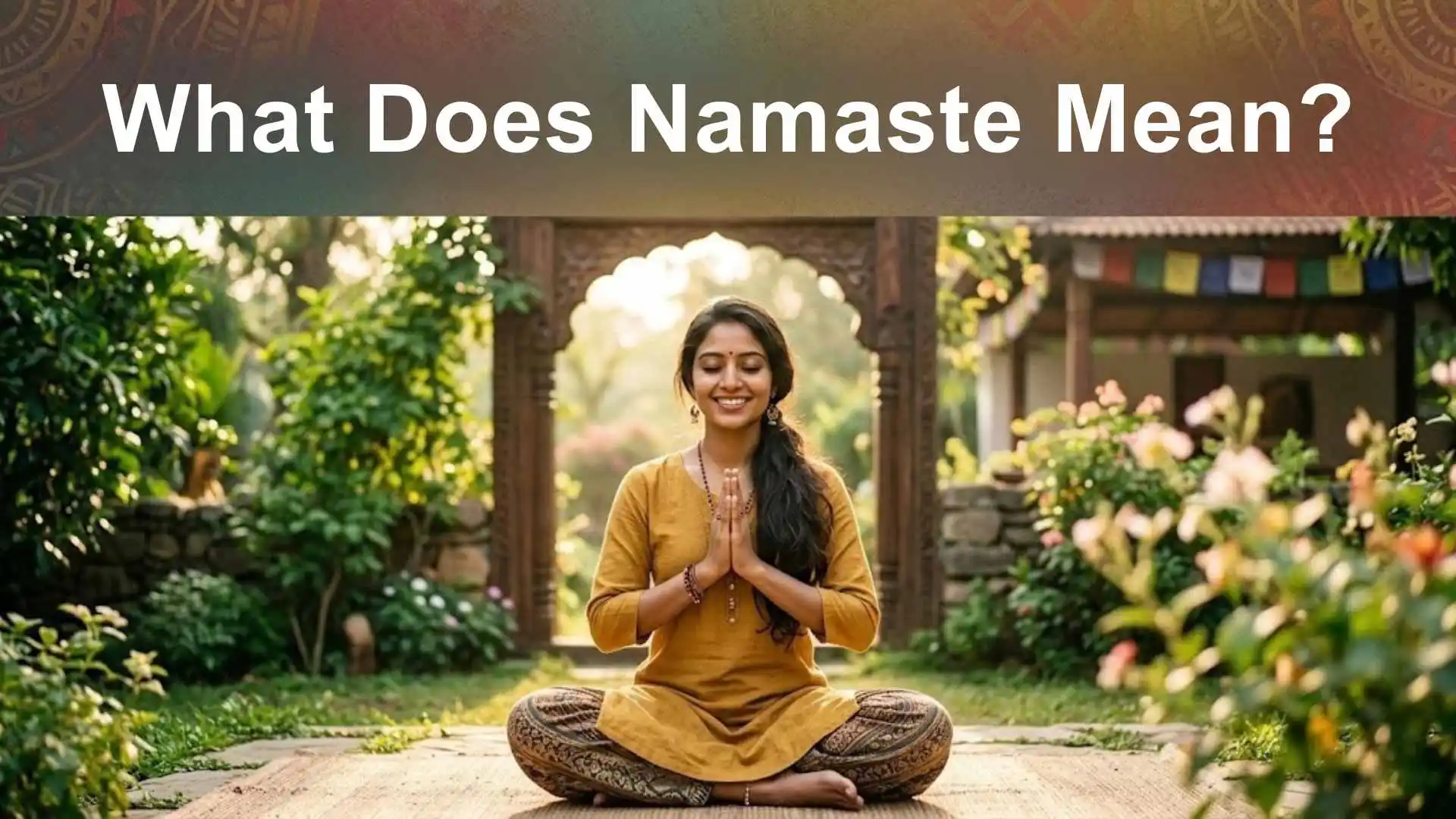
“What does namaste mean?” At first glance, it sounds like a simple yoga word you hear at the end of class. Yet this small Sanskrit greeting carries centuries of history, philosophy, and cultural depth.
When you understand the meaning of namaste, you stop treating it as trendy lingo and start seeing it as a respectful salutation rooted in South Asian tradition.
Let’s unpack its literal definition, pronunciation, gesture and spiritual layers without myths or exaggeration.
What Does Namaste Mean? The Clear, Literal Definition
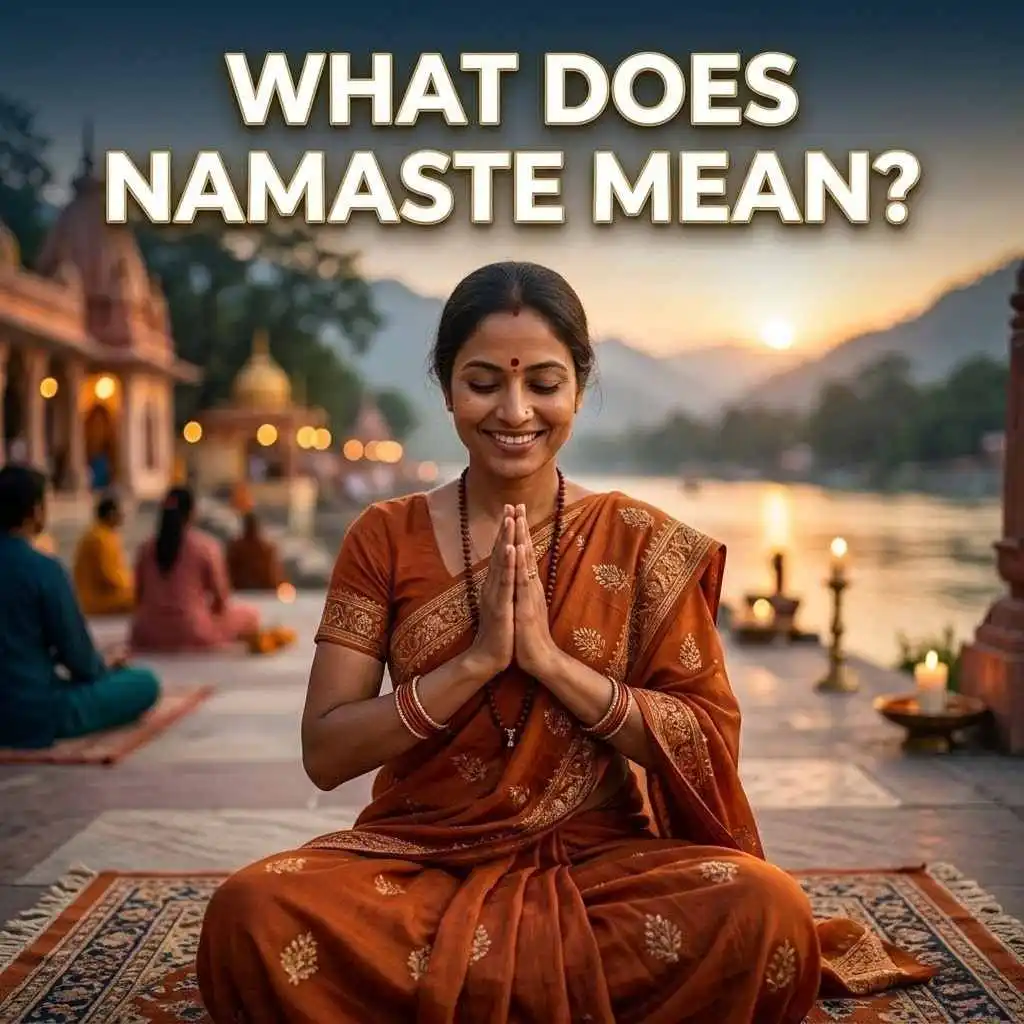
When people ask, “What is the namaste definition?” the most accurate answer is surprisingly simple.
Namaste literally means “I bow to you.”
The word comes from Sanskrit, an ancient Indo-Aryan language still used in liturgy and classical texts.
Break it down:
- Namah (नमः) = bow, reverence, adoration
- Te (ते) = to you
So grammatically, namaste = namah + te = I bow to you.
It’s direct. No mystical extras. No poetic embellishment. Just respect expressed in two syllables.
However, over time the phrase gained deeper spiritual interpretations, especially within Hinduism and yogic philosophy. That’s where you hear the expanded version:
“The divine in me honors the divine in you.”
This line captures a philosophical truth found in many Hindu texts. Yet it’s important to know this isn’t the literal translation. It’s an interpretive expression rooted in spiritual understanding.
Understanding this distinction matters. It prevents confusion and protects the integrity of the word.
The Sanskrit Roots Behind the Meaning of Namaste
Language shapes culture. Sanskrit words rarely carry just one layer of meaning.
The root anj means “to honor, celebrate, or anoint.” That’s where we also get Anjali Mudra, the sacred hand gesture associated with namaste.
Sanskrit often compresses entire ideas into small phrases. So while the literal translation is short, the emotional weight behind namaste meaning includes:
- Reverence
- Humility
- Acknowledgment of presence
- Recognition of shared humanity
In traditional Indian contexts, saying namaste isn’t dramatic. It’s normal. It’s everyday etiquette. That’s what makes it powerful.
How Is Namaste Pronounced?
Many people ask, how is namaste pronounced?
The correct pronunciation follows Sanskrit phonetics:
Nah-muh-stay
Not:
- Nah-mah-stay
- Nuh-mast
- Nah-mas-tay
Each vowel sounds clear and open. Sanskrit pronunciation doesn’t swallow syllables.
Here’s a simple phonetic guide:
| Syllable | Sound | Tip |
| Na | Nah | Soft, open “a” |
| Mas | Muhs | Light, not heavy |
| Te | Stay | Clear “tay” |
Why does pronunciation matter?
Because respectful language reflects intention. When you say a word correctly, you honor its origin.
The Namaste Gesture | Anjali Mudra Explained
The namaste gesture often accompanies the word itself. In Sanskrit, this gesture is called Anjali Mudra.
What Is Anjali Mudra?
- Press palms together
- Place hands at the sternum or heart center
- Slightly bow the head
That’s it.
The term mudra means gesture or seal. Anjali translates to offering or reverence.
This simple movement communicates humility without physical contact. In South Asian culture, it often replaces a handshake.
Symbolism Behind the Sacred Hand Gesture
This sacred hand gesture in yoga carries layered meaning.
Many traditions interpret the gesture as symbolizing:
- Unity between left and right
- Harmony between polarities
- Integration of mind and heart
- Acknowledgment of the divine spark within
In yogic philosophy, placing the hands near the heart connects with the heart chakra, also known as Anahata. Some practitioners also raise the hands to the forehead to acknowledge the third eye.
Still, the cultural meaning remains grounded in respect. The symbolism enhances it. It doesn’t replace it.
Cultural Significance of Namaste in South Asia
To understand what does namaste mean, you must understand where it lives.
In India, Nepal, and other parts of South Asia, namaste functions as a respectful greeting used daily.
People say it when they:
- Greet elders
- Meet guests
- Show gratitude
- Say goodbye
It crosses religious lines. While rooted in Sanskrit and associated with Hinduism, Buddhists and Jains also use it.
This is not a rare ritual phrase. It’s ordinary courtesy.
Hierarchy in Greetings
South Asian greetings often reflect social awareness.
When greeting someone older or in a position of respect:
- The bow may be slightly deeper
- The tone softer
- The gesture more pronounced
In contrast, greeting a close friend may involve a lighter gesture.
This subtle hierarchy shows how greeting etiquette communicates values like humility and relational awareness.
Namaste vs. Namaskar | What’s the Difference?
Many people confuse namaste vs namaskar.
Here’s the distinction:
| Feature | Namaste | Namaskar |
| Formality | Informal to semi-formal | More formal |
| Usage | Everyday greeting | Ceremonial or respectful address |
| Tone | Friendly respect | Elevated reverence |
Namaskar carries a slightly more formal tone. In some regions of India, it’s preferred in official settings.
Both share the same root meaning.
Namaste in Yoga | How It Entered Western Studios
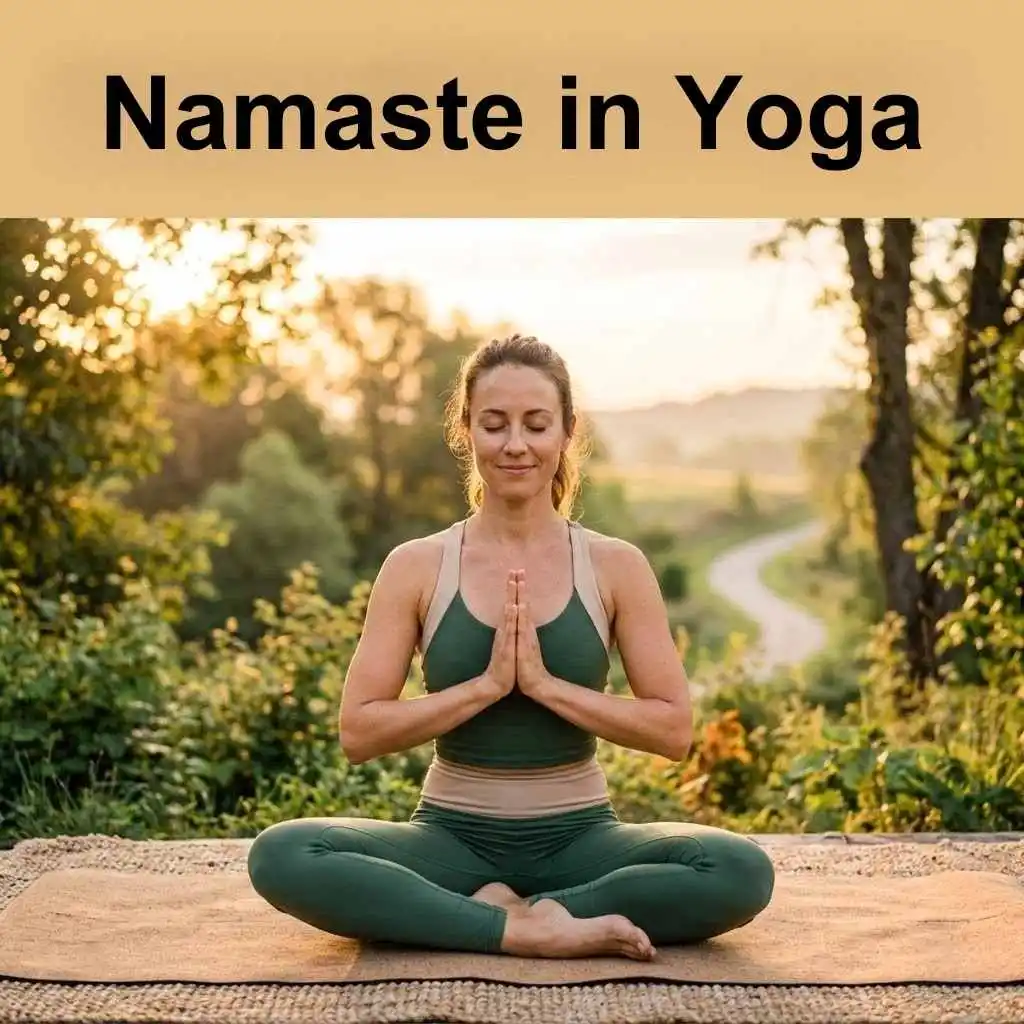
The word traveled west through yoga teachers in the 20th century. Influential figures like B.K.S. Iyengar helped introduce yoga philosophy and practice to the United States.
Over time, namaste became part of the yoga class ritual, often spoken at the end of sessions.
In many studios, the teacher says:
“Namaste.”
Students respond:
“Namaste.”
This exchange symbolizes gratitude between teacher and student.
However, not all traditional Indian yoga classes end this way. The Western adaptation shaped this custom.
The Popular Spiritual Interpretation
You’ve probably heard:
“The divine in me honors the divine in you.”
This interpretation gained traction in modern yoga communities. While it reflects Hindu philosophical ideas about the divine spark, it isn’t a direct translation.
The deeper idea connects to:
- Non-duality
- Unity of consciousness
- Recognition of shared being
In Sanskrit philosophy, particularly in Vedanta traditions, recognizing the divine within all beings aligns with the concept of spiritual awakening.
Yet historically, everyday users of namaste did not recite this explanation. They simply meant “I bow to you.”
Misuse of Namaste | Cultural Appropriation Concerns
As yoga grew popular, so did commercialization.
You’ve seen phrases like:
- “Nama-slay.”
- Decorative slogans on clothing.
- Casual use detached from context.
Critics argue this trend exoticizes sacred terms.
Yoga teachers such as Susanna Barkataki speak about cultural appropriation in yoga and encourage mindful language use.
The issue isn’t saying namaste. It’s using it without respect or awareness.
Intent matters. Context matters more.
When Should You Use Namaste?
Here’s practical guidance.
Appropriate Use of Namaste
- Greeting someone respectfully in South Asian settings
- Closing a yoga class where tradition is acknowledged
- During meditation practice
- Expressing gratitude in spiritual contexts
When Not to Use Namaste
- As slang
- As a punchline
- As a branding gimmick
- Without understanding its origin
If you’re unsure, observe the cultural setting first.
Is Namaste Religious?
People often ask whether namaste belongs strictly to religion.
Short answer: no.
While it originates from Sanskrit and appears in Hindu texts, it functions as a cultural greeting across religious communities.
Think of it this way:
- “Goodbye” originally meant “God be with ye.”
- Today it’s secular.
Similarly, namaste can be spiritual or purely respectful depending on context.
The Connection to Surya Namaskar
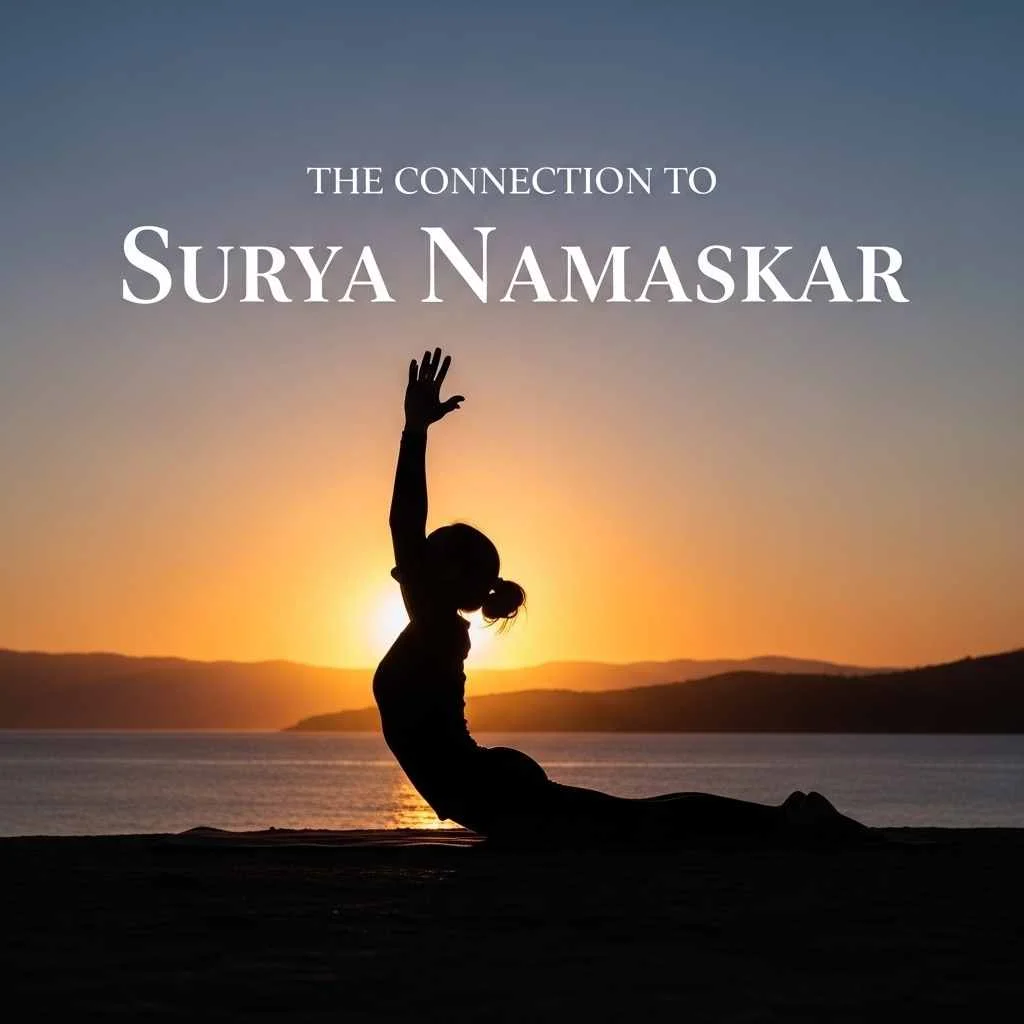
You may recognize the word in Surya Namaskar, commonly known as sun salutation.
Surya = sun
Namaskar = salutation
So the phrase means “salutation to the sun.”
This reinforces how the word conveys respect and reverence.
Spiritual Depth | Beyond the Literal Meaning
Though literal translation matters, spiritual seekers often explore deeper layers.
In yogic interpretation, namaste symbolizes:
- Surrender to the divine
- Recognition of internal duality
- Harmony between polarities
- Union of spirits
When used in meditation practice, the gesture becomes a quiet acknowledgment of inner awareness.
Still, grounding matters. Spiritual expansion should not erase cultural roots.
Quick Facts About Namaste
- Origin: Ancient Sanskrit
- Region: India and South Asia
- Literal Meaning: I bow to you
- Gesture: Anjali Mudra
- Formal Variant: Namaskar
- Used In: Greetings, yoga, meditation
Why Understanding the Meaning of Namaste Matters
Words carry lineage.
When you understand what does namaste mean, you avoid superficial use. You speak with awareness.
Respectful language builds cultural bridges instead of flattening differences.
A simple bow can hold centuries of wisdom.
Frequently Asked Questions
What does namaste literally translate to?
It translates directly to “I bow to you.”
How do you properly pronounce namaste?
Nah-muh-stay, with clear vowel sounds.
Is it disrespectful for non-Indians to say namaste?
Not inherently. Intent and respectful context determine appropriateness.
What is the difference between namaste and namaskar?
Namaskar is more formal.
Why do yoga teachers say namaste at the end of class?
To express gratitude and mutual respect between teacher and students.
Conclusion
Namaste isn’t a trendy yoga catchphrase. It’s a Sanskrit term rooted in humility and cultural tradition. At its core, the meaning remains beautifully simple: I bow to you. When spoken with awareness, the word becomes a bridge between people rather than a borrowed decoration.
Understanding its pronunciation, history, and spiritual depth allows you to use it with integrity. And sometimes, that small bow says more than a thousand words.

Tyler Wells is an American author known for his captivating storytelling and thoughtful insights into modern life. With a natural talent for weaving words into meaningful narratives, he has built a strong connection with readers who appreciate both authenticity and imagination.
Over the years, Tyler has written several acclaimed books, including “Echoes of the Dawn” (a moving story about hope and new beginnings), “Whispers Between the Lines” (a heartfelt story exploring love, loss, and resilience), and “The Silent Hour” (a suspenseful drama that keeps readers turning pages late into the night). His works blend emotional depth with relatable characters, making them both timeless and relevant for today’s audience.
Beyond writing, Tyler enjoys sharing his thoughts on creativity, personal growth, and the human experience. Whether through his books or his articles, he inspires readers to look at life from new perspectives and embrace their own stories with courage.