

“What does ION mean in text?” You’ve probably seen this short word pop up in chats, TikTok comments, or late night group messages.
At first glance, it looks confusing, almost like a typo. However, ION is actually a powerful piece of modern internet slang with two completely different meanings.
Once you understand its context, capitalization, and tone, you’ll instantly recognize what someone means and even use it naturally yourself.
What Does ION Mean in Text?

The ION meaning in text depends entirely on context, capitalization, and conversational tone. In modern digital communication, ION has two primary meanings:
- ION = In Other News
- ion = I don’t
Both meanings belong to internet slang, but they serve different functions in conversation. One shifts topics. The other replaces words to make typing faster.
Here’s a clear breakdown:
| Form | Meaning | Type | Function | Example |
| ION | In Other News | abbreviation | topic shift marker | ION I got a new job |
| ion | I don’t | informal contraction | casual speech shortcut | ion like that movie |
This simple three-letter term plays a big role in online communication language, especially in texting, social media, and chat platforms.
ION Meaning #1 | ION as “In Other News”
The most widely accepted and accurate ION abbreviation meaning is In Other News.
This usage acts as a conversational marker, which helps speakers shift topics naturally. Think of it as a bridge between ideas.
Why people use ION to mean “In Other News”
People use ION slang to:
- Change the subject smoothly
- Introduce unrelated information
- Add random thoughts
- Keep conversations flowing naturally
- Avoid awkward pauses
Instead of saying:
“By the way, something else happened.”
They simply say:
“ION something else happened.”
Short. Clean. Effective.
Real Text Examples of ION Meaning “In Other News”
These examples show real ION usage in chat:
Example 1:
- Friend: That movie was terrible
- You: Yeah it was boring
- You: ION I started watching a new series
Example 2:
- Friend: I’m tired today
- You: Same honestly
- You: ION I might go to the gym later
Example 3:
- Friend: I failed my test
- You: That sucks
- You: ION I passed mine
Notice how ION functions as a topic transition marker. It introduces new information without needing long explanations.
Why “In Other News” Became Popular in Internet Slang
The phrase In Other News originally came from journalism. News anchors used it to shift between stories.
Example:
“In other news, the economy grew this quarter.”
Eventually, people brought this phrase into digital slang, shortening it into ION abbreviation.
This evolution happened because internet users prefer:
- Faster typing
- Less effort
- Efficient communication
- Casual conversational tone
Modern internet culture rewards speed and simplicity.
ION Meaning #2 | ion as “I don’t”
The second meaning of ion meaning slang is completely different.
In lowercase form, ion means “I don’t.”
This version acts as an informal contraction.
Example:
- ion know = I don’t know
- ion care = I don’t care
- ion like it = I don’t like it
This version reflects natural speech patterns. People type how they speak.
Why People Type “ion” Instead of “I don’t”
Several linguistic and psychological reasons explain this shift:
Faster typing
Typing “ion” takes less effort than typing “I don’t.”
Speech pattern reflection
Many people pronounce “I don’t” quickly, which sounds like “ion.”
Casual tone
It creates a relaxed conversational feel.
Internet culture influence
Platforms like TikTok, Discord, and Twitter encourage shortened language.
Examples of ion Meaning “I Don’t”
Here are real examples from online messaging:
- ion understand this homework
- ion feel like going outside
- ion want pizza today
- ion remember that
Now compare:
| Slang | Standard English |
| ion know | I don’t know |
| ion care | I don’t care |
| ion see anything | I don’t see anything |
This version appears heavily in casual messaging, especially among younger users.
Capitalization Matters | ION vs ion Meaning Difference
Capitalization completely changes the meaning.
This is one of the most important things to understand.
| Version | Meaning | Function | Category |
| ION | In Other News | discourse marker | INTERNET_SLANG |
| ion | I don’t | informal contraction | INFORMAL_LANGUAGE |
This difference reflects a broader linguistic principle called context-dependent meaning.
The brain interprets meaning based on:
- capitalization
- sentence structure
- conversational tone
How ION Functions as a Discourse Marker
In linguistics, ION acts as a discourse marker.
Discourse markers help manage conversation flow.
Examples of discourse markers:
- Well
- Anyway
- By the way
- So
- ION
These words guide the listener or reader.
ION specifically signals a topic shift.
Example:
ION I got accepted into college
The brain instantly recognizes a shift in conversation.
Real Conversation Examples Showing Both Meanings
Understanding comes easier with realistic examples.
Example 1: Topic shift meaning
Friend: I’m bored
You: Same honestly
You: ION I might go for a walk
Meaning: In Other News
Example 2: Contraction meaning
Friend: Do you like that movie
You: ion like it
Meaning: I don’t like it
Example 3: Social media usage
Comment: This song is overrated
Reply: ion agree
Meaning: I don’t agree
Where You’ll See ION Most Often
ION appears across nearly every major platform.
Most common platforms
- TikTok
- Discord
- Twitter (X)
- Snapchat
- Instagram
- WhatsApp
- Group chats
- Reddit
These platforms encourage fast, informal communication.
Why Modern Internet Culture Uses Slang Like ION
Internet language evolves constantly.
People prefer slang because it:
- saves time
- feels natural
- expresses personality
- builds social identity
This phenomenon belongs to modern language evolution.
Origin of ion Meaning “I don’t”
The lowercase ion meaning I don’t slang originates from African American Vernacular English (AAVE).
AAVE influenced much of today’s internet slang terms.
Speech patterns in AAVE naturally shorten phrases.
Example pronunciation:
“I don’t know” becomes “ion know”
This linguistic pattern moved into:
- texting
- online chat
- meme culture
- social media communication
Eventually, it became mainstream.
Origin of ION Meaning “In Other News”
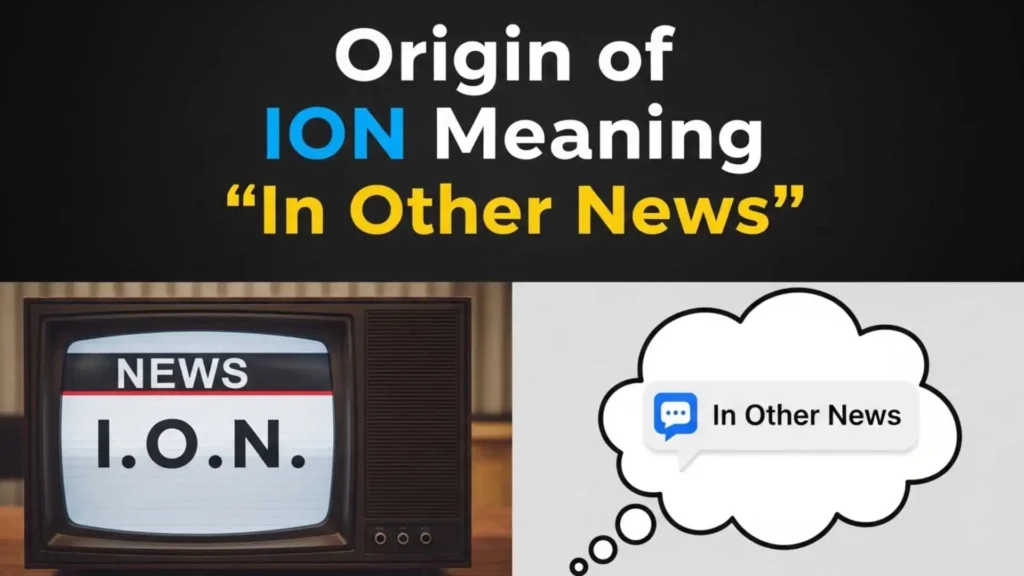
This version originated from journalism.
News anchors used the phrase to transition topics.
Example:
“In other news, scientists discovered something new.”
Internet users shortened it into ION.
This reflects a process called semantic shift.
Semantic shift occurs when language meaning evolves.
When You Should Use ION in Text
ION works best in informal settings.
Appropriate situations
Use ION when texting:
- friends
- family
- classmates
- online communities
Use ion when expressing casual disagreement:
- ion agree
- ion care
- ion want that
When You Should NOT Use ION
Avoid using ION in formal communication.
Avoid using ION in:
- job applications
- professional emails
- academic writing
- workplace communication
Instead, use proper grammar.
Example:
Instead of:
ion agree
Use:
I do not agree
Why Context Is Critical for Understanding ION Meaning
Context determines meaning.
Look at these examples:
ION I got a promotion
→ topic shift
ion want that
→ means I don’t want that
Your brain analyzes sentence structure instantly.
Similar Internet Slang Terms Related to ION
Here are other common text abbreviations:
| Slang | Meaning |
| LOL | Laugh Out Loud |
| TBH | To Be Honest |
| BRB | Be Right Back |
| ICYMI | In Case You Missed It |
| IDK | I Don’t Know |
| IMO | In My Opinion |
These belong to the same category as ION internet slang.
Why ION Became Popular So Quickly
Several psychological and technological factors drove adoption.
Major reasons
Speed efficiency
People want faster typing.
Social belonging
Using slang signals membership in internet culture.
Mobile keyboard limitations
Shorter words reduce effort.
Meme culture influence
Memes spread slang rapidly.
Psychological Impact of Slang Like ION
Slang creates emotional connection.
It makes conversations feel:
- personal
- casual
- relaxed
- natural
Formal language feels distant.
Slang feels human.
How Teenagers and Young Adults Use ION
Younger generations use slang heavily.
Examples:
- ion care what they say
- ION I’m going outside
- ion like that teacher
This pattern reflects digital communication culture.
How ION Improves Conversational Flow

ION acts like conversational glue.
Without it:
Conversation feels abrupt.
With it:
Conversation flows smoothly.
Example:
Without ION:
I finished homework. I bought food.
With ION:
I finished homework. ION I bought food
Smooth transition.
Linguistic Classification of ION
ION belongs to multiple linguistic categories.
| Category | Classification |
| INTERNET_SLANG | Yes |
| ABBREVIATION | Yes |
| INFORMAL_LANGUAGE | Yes |
| DISCOURSE_MARKER | Yes |
| DIGITAL_COMMUNICATION_TERM | Yes |
How to Tell Which Meaning Someone Is Using
Use these clues:
Capitalization clue
ION → In Other News
ion → I don’t
Context clue
ION I got food → topic shift
ion want food → means I don’t want food
Is ION Still Popular in 2025?
Yes. It continues growing rapidly.
Reasons include:
- TikTok influence
- Discord culture
- Gen Z communication style
- Short-form content culture
Slang evolves constantly.
ION remains relevant.
Quick Summary Table of ION Meaning in Text
| Version | Meaning | Usage |
| ION | In Other News | topic shift |
| ion | I don’t | contraction slang |
FAQs About ION Meaning in Text
What does ION mean in text slang?
ION means In Other News or I don’t, depending on context and capitalization.
What does ion mean from a girl or guy?
It means I don’t. Gender does not change the meaning.
Is ION rude?
No. It’s casual slang. However, avoid using it in formal situations.
What does ION mean on TikTok?
It means either In Other News or I don’t, depending on context.
Is ION a real acronym?
Yes. It’s a recognized internet abbreviation used in digital communication.
Why do people type ion instead of I don’t?
It saves time and reflects natural speech patterns.
Conclusion
ION is a powerful example of how modern language evolves through internet culture. It can mean In Other News when shifting topics or I don’t when written in lowercase. Context and capitalization determine its meaning instantly.
This slang dominates texting, social media, and casual conversations. Once you understand it, you’ll recognize it everywhere and use it confidently.

Tyler Wells is an American author known for his captivating storytelling and thoughtful insights into modern life. With a natural talent for weaving words into meaningful narratives, he has built a strong connection with readers who appreciate both authenticity and imagination.
Over the years, Tyler has written several acclaimed books, including “Echoes of the Dawn” (a moving story about hope and new beginnings), “Whispers Between the Lines” (a heartfelt story exploring love, loss, and resilience), and “The Silent Hour” (a suspenseful drama that keeps readers turning pages late into the night). His works blend emotional depth with relatable characters, making them both timeless and relevant for today’s audience.
Beyond writing, Tyler enjoys sharing his thoughts on creativity, personal growth, and the human experience. Whether through his books or his articles, he inspires readers to look at life from new perspectives and embrace their own stories with courage.