

“What does FML mean?” It’s one of the most recognizable pieces of internet slang in modern digital culture.
You’ve seen it in texts, memes, captions, and tweets when something goes hilariously wrong. Three letters. Big emotion.
This guide breaks down the FML meaning, its origin, emotional tone, social function, and how to use it correctly in texting and on social media.
No fluff. Just the facts, real examples, and practical insight you can actually use.
FML Meaning Explained | Definition, Full Form and Tone
Let’s start with the basics.
FML is an acronym that stands for “F* My Life.”**
It’s a censored expletive (censored form) used to express frustration, annoyance, or ironic despair.
In spoken form, people often say:
- “F my life.”
- Or simply “Eff my life.”
Quick Definition Snapshot
| Term | Type | Full Form | Tone | Context |
| FML | Acronym | F*** My Life | Frustration, sarcasm | Casual |
| TL;DR | Acronym | Too Long; Didn’t Read | Dismissive | Online |
| YOLO | Acronym | You Only Live Once | Bold | Social |
| SMH | Acronym | Shaking My Head | Disapproval | Informal |
| IDC | Acronym | I Don’t Care | Indifference | Texting |
Unlike some texting abbreviations, FML carries emotional weight. It’s not neutral. It signals a reaction.
And here’s the nuance:
Sometimes it’s serious.
Often it’s exaggerated.
Most of the time it’s self-aware humor.
That flexibility explains its staying power.
The Origin of FML | Where It Actually Came From
Language rarely appears out of nowhere. FML emerged during the late 2000s wave of post-Y2K slang and digital storytelling culture.
The phrase exploded in popularity thanks to Fmylife.com, a website launched in 2008 where users submitted short, real-life stories about embarrassing or unlucky situations. Each entry ended with “FML.”
The format was simple:
“Today, I accidentally sent a love text to my boss instead of my boyfriend. FML.”
Short. Painful. Relatable.
By 2009, the trend became mainstream with the publication of The FMyLife Book, which compiled user submissions into print form. That moment cemented FML as part of mainstream internet culture.
Why It Spread So Fast
Several factors fueled its rise:
- Growth of social platforms like Facebook
- Microblogging on Tumblr
- Real-time reactions on X
- Story-sharing on Reddit
- Visual humor on Instagram
These platforms rewarded short, punchy content. FML fit perfectly.
What Emotional Tone Does FML Carry?
FML functions as a tone indicator in digital communication. It tells the reader how to interpret the message.
Core Emotional States Associated with FML
- Frustration
- Annoyance
- Exasperation
- Sarcasm
- Irony
- Self-deprecating humor
- Mild despair
- Playful exaggeration
Notice something important. Most uses involve mild inconvenience, not tragedy.
That distinction matters.
When someone misses a bus and says FML, they’re signaling “this is annoying.”
They’re not signaling actual crisis.
Situations That Trigger an FML Moment
Let’s get specific. These are classic triggers.
Everyday Inconveniences
- Missing an important appointment
- Spilling coffee on a white shirt
- Locking keys inside the car
- Hitting “reply all” by mistake
- Losing unsaved work
- Phone dying at 1%
- Finals week stress
Social Embarrassment
- Texting the wrong person
- Tripping in public
- Forgetting someone’s name mid-conversation
Travel Disasters
- Screaming baby on a flight
- Flight delay after boarding
- Hotel booking error
These moments share three traits:
- They’re frustrating.
- They’re relatable.
- They’re survivable.
That’s the emotional sweet spot of FML slang meaning.
How to Use FML in Texting
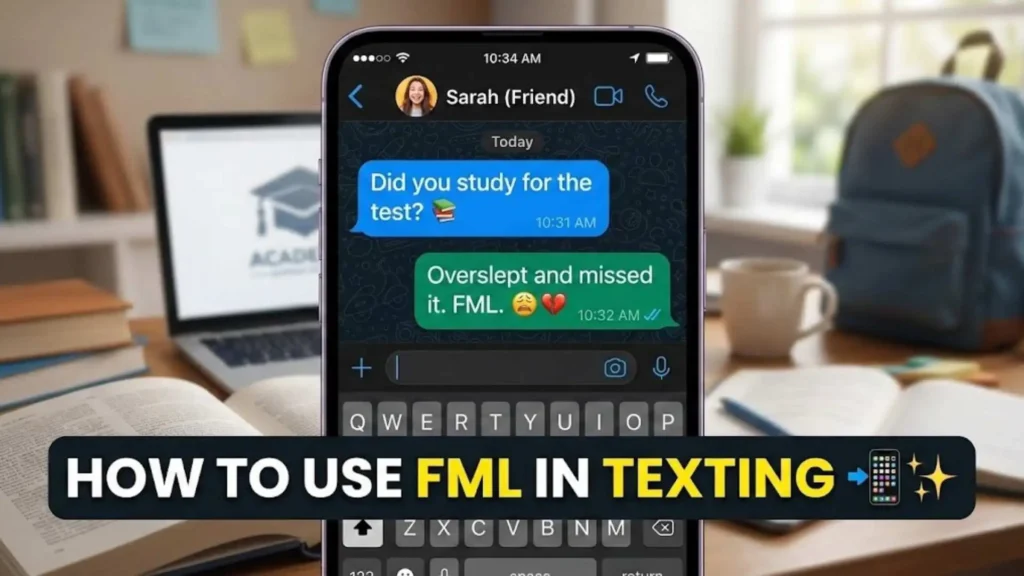
In texting abbreviations, speed matters. FML delivers emotion instantly.
Example in a Text Conversation
Friend: “Did you study for the test?”
You: “Overslept and missed it. FML.”
Short sentences. Immediate reaction.
Why It Works in Texting
- It saves time.
- It avoids long emotional explanations.
- It signals tone clearly.
You don’t need a paragraph. Three letters do the job.
FML on Social Media
On social platforms, FML often becomes part of a mini story.
Classic Social Media Structure
- Short narrative
- Punchline
- FML
Example:
“Spent two hours getting ready for a date. They canceled 10 minutes before. FML.”
That format mirrors the original style popularized by Fmylife.com.
The Pragmatic Intent Behind FML
Language always serves a purpose. FML isn’t random.
1. Venting Mechanism
It allows quick emotional release without sounding dramatic.
2. Social Bonding
When someone posts FML, others respond with:
- “Same.”
- “That’s rough.”
- “I’ve been there.”
Shared frustration builds connection.
3. Downplaying Situations
Sometimes FML softens the blow of a bigger issue.
Instead of saying “I’m devastated,” someone says “FML” to make it lighter.
4. Humor Coping Strategy
Turning annoyance into a joke reduces stress. Humor creates emotional distance.
That’s powerful.
Is FML Always Negative?
Not exactly.
Tone depends on context.
Add a laughing emoji and it becomes playful.
Say it flat and it sounds serious.
Here’s a comparison:
| Version | Tone Interpretation |
| “Missed my train. FML.” | Genuine frustration |
| “Missed my train 😂 FML” | Playful annoyance |
| “Spilled water. FML.” | Mild inconvenience |
| “Lost my job. FML.” | Heavy despair |
The phrase scales emotionally based on context.
Generational Linguistics | Who Uses FML?
FML emerged strongly among Millennials in the late 2000s.
Later, Gen Z and Zoomers adopted it, sometimes ironically.
Usage Timeline
| Era | Trend |
| Late 2000s | Rapid growth |
| Early 2010s | Peak popularity |
| 2020s | Stable but less dominant |
Today, FML remains recognizable across age groups. It’s part of the broader ecosystem of modern slang expressions.
FML vs Other Internet Acronyms
FML belongs to a larger family of online acronyms.
Let’s compare.
| Acronym | Meaning | Emotional Focus | Example Use |
| FML | F*** My Life | Frustration | “Forgot my wallet. FML.” |
| TL;DR | Too Long; Didn’t Read | Summary | “TL;DR: It didn’t work.” |
| YOLO | You Only Live Once | Risk-taking | “Booked the trip. YOLO.” |
| SMH | Shaking My Head | Disapproval | “He forgot again. SMH.” |
| IDC | I Don’t Care | Indifference | “IDC anymore.” |
Each acronym functions as emotional shorthand.
When You Should NOT Use FML
Despite its popularity, FML doesn’t belong everywhere.
Avoid it in:
- Professional emails
- Academic essays
- Job interviews
- Formal presentations
- Corporate reports
Why?
Because it contains implied profanity. Even censored, it signals casual language.
If the setting requires formal tone, skip it.
The Evolution of Slang | Why FML Survived
Slang usually fades fast. Yet FML remains in circulation.
Why?
1. Emotional Efficiency
Three letters replace a sentence.
2. Cultural Memory
People who grew up during early 2010s meme culture still recognize it.
3. Relatability
Everyone experiences minor disasters.
4. Adaptability
It works in text, speech, memes, captions, and stories.
That versatility keeps it alive.
Psychological Insight | Why We Love Dramatic Exaggeration
FML is rarely literal.
It’s exaggerated on purpose.
This reflects a common human tendency called playful overstatement. When something mildly annoying happens, we amplify it for comedic effect.
For example:
- “This traffic is ruining my life.”
- “My WiFi died. I’m done.”
- “Spilled cereal. FML.”
It’s emotional shorthand mixed with humor.
That blend makes it sticky.
FML in Offline Conversations
Although born online, people now say FML aloud.
Example:
“I studied the wrong chapter. F my life.”
Spoken usage usually happens among friends. Rarely in formal settings.
The phrase transitioned from digital to real-world language. That shift signals cultural integration.
Cultural Impact of FML
At its peak, FML shaped internet storytelling culture.
Short-form confession style content thrived because:
- It felt authentic.
- It invited empathy.
- It encouraged participation.
User-generated humor sites expanded rapidly during that era. FML became symbolic of digital-age expressions.
Is FML Offensive?
Technically, yes.
It contains censored profanity. However, its impact depends on context.
Consider These Factors
- Audience age
- Professional setting
- Cultural norms
- Platform type
Among friends, it’s harmless.
In corporate communication, it’s risky.
Context rules everything.
Common Misunderstandings About FML
Myth: FML Means Serious Depression
Not usually. Most usage reflects minor frustration.
Myth: It’s Outdated Slang
It peaked in early 2010s but remains widely understood.
Myth: Only Young People Use It
Adults who grew up in early social media culture still use it casually.
How FML Reflects Digital Communication Trends
FML fits into a broader pattern of:
- Shortened language
- Emotional shorthand
- Casual internet language
- Expressive minimalism
Modern communication values speed. Attention spans shrink. Messages compress.
FML is compression at its finest.
Real Examples of FML in Different Contexts
Text Message
“Phone died during GPS navigation. FML.”
Group Chat
“Professor changed exam date to tomorrow. FML.”
Social Media Caption
“Spent an hour cooking and burned everything. FML.”
Spoken Among Friends
“Locked myself out again. F my life.”
Notice the consistent pattern.
Minor crisis.
Immediate reaction.
Quick resolution.
Should You Still Use FML in 2026?
Yes, if the setting is informal.
It remains recognizable across Millennials, Gen Z, and casual internet users. It’s not cutting-edge slang anymore, yet it’s culturally embedded.
Think of it like a classic meme.
It may not trend daily, yet everyone understands it.
Final Thoughts | Why Three Letters Still Matter
FML stands for more than frustration. It represents a cultural moment in digital communication. It captures annoyance, humor, irony, and exaggeration in one compact expression.
From late 2000s storytelling platforms to modern texting culture, it remains a shorthand for relatable human moments.
When something small goes wrong, you don’t need a speech. Sometimes you just need three letters.
Discover More:
- What Does Coinsurance Mean? A Clear, Practical Guide to How Coinsurance Works in Health Insurance
- What Does Shared With You Mean on TikTok? The Complete Breakdown of the Shared With You Feature, Algorithm and Privacy Controls
- What Does FYP Mean? The Complete Guide to FYP on TikTok and Instagram

Ashton Cole is an American author celebrated for his compelling storytelling and ability to capture the depth of human emotions. His works often explore themes of love, resilience, and self-discovery, making him a relatable voice for readers around the world.
He has published several well-received books, including:
-
Whispers of Dawn – a reflective novel about finding hope in life’s darkest moments.
-
Beneath the Silent Sky – a moving story of love, memory, and the bonds that shape us.
-
The Edge of Forever – a thought-provoking tale that blends drama, destiny, and the courage to begin again.
Through his writing, Ashton strives to inspire readers to see beauty in both the struggles and triumphs of life. When he isn’t writing, he enjoys exploring new cities, collecting rare books, and spending time in cozy coffee shops where many of his story ideas take shape.