

“What does etc mean?” You’ve probably seen this tiny abbreviation everywhere in school assignments, emails, books and even text messages.
Yet many people don’t fully understand its exact meaning or how to use it correctly.
This small term carries an important role in writing, helping you shorten lists and avoid repetition.
Once you understand its definition, origin and rules, you’ll use it confidently and correctly in every situation.
What Does “Etc” Mean?
The abbreviation “etc.” means “and other similar things” or “and so on.” It tells the reader that there are more items in a list, but they are not written because they are obvious or similar.
In simple words, etc. saves time and space by avoiding long lists.
Basic examples:
- I bought apples, bananas, oranges, etc.
- She likes painting, drawing, sketching, etc.
- You need pens, notebooks, folders, etc.
In each example, “etc.” indicates that more similar items exist.
What Does “Etc” Stand For?
The full form of etc. is “et cetera.” It comes from Latin.
- Et = and
- Cetera = the rest or other things
So, et cetera literally means “and the rest.”
This Latin phrase became widely used in English and was later shortened to etc. for convenience.
How to Pronounce “Etc” Correctly
Many people see “etc.” in writing but don’t know how to pronounce it properly.
Correct pronunciation:
et-set-er-uh
Phonetic breakdown:
- et → “et”
- ce → “set”
- tera → “er-uh”
Incorrect pronunciations to avoid:
- ❌ ek-set-ra
- ❌ et-see-tra
- ❌ et-ka-tra
You don’t pronounce each letter separately. Instead, pronounce it as the full phrase “et cetera.”
How to Use “Etc.” in a Sentence
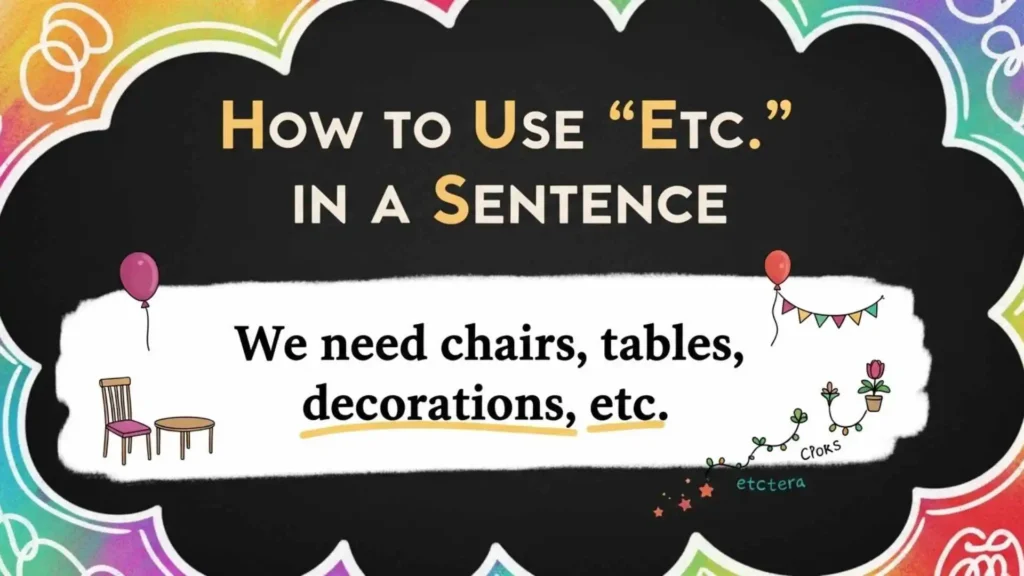
You use “etc.” at the end of a list when similar items continue but are not written.
Everyday examples:
- We need chairs, tables, decorations, etc.
- He enjoys football, cricket, tennis, etc.
Academic examples:
- Students must bring pencils, erasers, rulers, etc.
- The course covers grammar, vocabulary, pronunciation, etc.
Business examples:
- Please submit reports, invoices, receipts, etc.
- Employees must follow rules, policies, procedures, etc.
Casual examples:
- I watch Netflix, YouTube, movies, etc.
- She bought clothes, shoes, bags, etc.
Grammar Rules for Using “Etc.”
Understanding grammar rules ensures correct and professional usage.
Rule 1: Always Use a Period After “Etc.”
Because “etc.” is an abbreviation, it always ends with a period.
✔ Correct:
- Bring books, pens, etc.
❌ Incorrect:
- Bring books, pens, etc
Rule 2: Use a Comma Before “Etc.” When Needed
When etc. follows a list, use a comma before it.
✔ Correct:
- Apples, bananas, oranges, etc.
❌ Incorrect:
- Apples, bananas, oranges etc.
Rule 3: Never Use “And Etc.”
Using “and etc.” is incorrect because “etc.” already means “and the rest.”
❌ Incorrect:
- Apples, bananas, and etc.
✔ Correct:
- Apples, bananas, etc.
Rule 4: Do Not Overuse “Etc.”
Overusing “etc.” makes writing unclear and lazy.
❌ Weak:
- I like food, etc.
✔ Strong:
- I like Italian food, Chinese food, Mexican food, etc.
Common Mistakes People Make with “Etc.”
Many writers use “etc.” incorrectly. Here are the most common mistakes:
| Mistake | Incorrect Example | Correct Example |
| Wrong spelling | ect. | etc. |
| Missing period | etc | etc. |
| Using with “and” | and etc. | etc. |
| Overuse | things, etc. | tools, equipment, etc. |
| Using after complete list | Sun, Moon, Earth, etc. | Sun, Moon, Earth |
The most common mistake is writing “ect.” instead of “etc.”
Is “Etc.” Formal or Informal?
“Etc.” can be both formal and informal depending on the situation.
Informal usage (acceptable):
- Text messages
- Emails
- Blogs
- Casual writing
Formal usage (sometimes avoided):
- Academic research papers
- Legal documents
- Professional reports
In formal writing, it’s often better to write complete lists.
When You Should NOT Use “Etc.”
Avoid using “etc.” when clarity is important.
Do not use etc. when:
- Writing academic research papers
- Writing legal documents
- Giving important instructions
- Providing exact information
- Listing complete categories
Example:
❌ Weak: Bring required documents, etc.
✔ Better: Bring passport, ID card, and birth certificate.
Alternatives to “Etc.”
You can use alternatives to sound more professional.
| Alternative | Example |
| And so on | Books, pens, and so on |
| And others | Teachers, students, and others |
| Among others | Skills like writing, editing, among others |
| Such as | Subjects such as math and science |
| Including | Activities including reading and writing |
These alternatives improve clarity.
Etc. vs Etcetera | Which Should You Use?
Both are correct.
- Etc. → abbreviation (most common)
- Et cetera → full phrase (formal)
Example:
- Correct: Books, papers, etc.
- Also correct: Books, papers, et cetera.
Most writers prefer etc.
Is It Rude to Use “Etc.”?
Sometimes, yes. It depends on context.
Using “etc.” can sound dismissive if you avoid giving details.
Example:
❌ Rude: Complete your tasks, etc.
✔ Better: Complete your report and submit it by Friday.
Be specific in professional situations.
Should You Use “Etc.” in Academic Writing?
Teachers often discourage using “etc.” in academic writing.
Reasons:
- It is vague
- It reduces clarity
- It appears lazy
Instead, list specific examples.
Real Life Examples of “Etc.”
You see “etc.” everywhere in daily life.
Text messages:
Bring snacks, drinks, etc.
Job descriptions:
Responsibilities include training, reporting, planning, etc.
Shopping lists:
Milk, eggs, bread, etc.
School assignments:
Use pencils, rulers, erasers, etc.
Quick Grammar Rules Summary
| Rule | Correct | Incorrect |
| Use period | etc. | etc |
| Don’t use “and” | books, etc. | books and etc. |
| Use after list | apples, oranges, etc. | apples, etc, oranges |
| Spell correctly | etc. | ect. |
FAQs About “Etc.”
What does etc mean in text?
It means “and other similar things.”
What does etc stand for?
It stands for “et cetera.”
Can you start a sentence with etc.?
No, avoid starting sentences with etc.
Do you capitalize etc.?
No, unless it starts a sentence (which is rare).
Is etc formal?
It can be formal, but avoid it in strict academic writing.
Why “Etc.” Is Useful in Writing
Etc. helps writers:
- Save time
- Avoid repetition
- Keep sentences shorter
- Improve readability
It makes writing more efficient.
History and Origin of “Etc.”
The term originated from Latin thousands of years ago. Scholars used et cetera in academic and religious texts. Over time, English adopted it and shortened it to etc.
Today, it is one of the most commonly used abbreviations in English.
Conclusion
Understanding what does etc mean helps you write clearly, correctly, and professionally. This small abbreviation stands for “et cetera,” meaning “and the rest,” and it helps shorten lists without losing meaning.
However, using it correctly requires following proper grammar rules, punctuation, and context. When used properly, etc. makes writing more efficient, but avoid overusing it in formal or academic situations. Mastering this simple term improves both your writing confidence and communication skills.

Edward Grant is an American author known for his modern storytelling and thought-provoking narratives. With a passion for exploring human emotions, relationships, and the complexities of everyday life, Edward writes in a style that feels both relatable and inspiring. His journey as a writer began in his early 20s, fueled by a love for literature and a deep curiosity about the world around him.
Over the years, Edward has developed a reputation for crafting characters that feel real, layered, and unforgettable. Whether he’s writing contemporary fiction or reflective essays, his work resonates with readers who value authenticity and emotional depth. Beyond writing, Edward is also an avid reader and enjoys spending time in quiet libraries and creative workspaces where new ideas come to life.
Some of his notable works include Whispers of Tomorrow, Shadows of the Heart, and The Last Horizon, each of which has received appreciation for its unique voice and meaningful storytelling.