

“What does Allahu Akbar mean?” It’s a question millions ask, often after hearing the phrase in news clips or during Islamic prayer. Many people assume they know the answer. Few understand its depth.
This article explains the meaning of Allahu Akbar, its Arabic structure, its spiritual force, and why nearly 2 billion Muslims repeat it daily with devotion and peace.
Let’s strip away noise. Let’s uncover truth.
What Does Allahu Akbar Mean? The Clear Translation and Core Meaning
At its most direct level, Allahu Akbar means:
“Allah is Greater.”
Not simply “God is great.”
Not only “God is the greatest.”
The phrase carries a comparative force. It declares that Allah is greater than anything you can imagine.
Break it down carefully:
| Word | Arabic | Meaning | Function |
| Allah | الله | The proper name of God | Subject |
| Akbar | أكبر | Greater / Greatest | Comparative form |
The phrase does not mention what Allah is greater than. Arabic deliberately leaves that open. That omission makes it powerful. It means:
- Allah is greater than fear
- Allah is greater than power
- Allah is greater than wealth
- Allah is greater than hardship
- Allah is greater than success
This open-ended comparison gives the phrase emotional elasticity. It expands based on your situation.
That is the real Allahu Akbar translation.
The Arabic Meaning of Allahu Akbar | Linguistic Depth Explained
To understand the phrase fully, you need to explore the Arabic root k-b-r (ك ب ر).
Arabic operates through a trilateral root system. Most words derive from three root letters. In this case:
- Kāf (ك)
- Bā (ب)
- Rā (ر)
This root relates to greatness, size, and magnitude.
From that root, we get:
| Word | Form | Meaning |
| Kabīr | Basic adjective | Great |
| Akbar | Ism tafdīl | Greater / Greatest |
| Takbīr | Verbal noun | Saying “Allahu Akbar” |
What Is Ism Tafdīl?
Ism tafdīl is a grammatical form in Arabic used for comparison. It expresses both comparative and superlative meanings depending on context.
So Akbar literally means:
- Greater
- The greatest
However, linguistically, “greater” captures the dynamic sense better. Arabic rhetoric often omits the object of comparison for emphasis. That omission suggests infinity.
This is not poetic exaggeration. It is precise Arabic grammar.
When Muslims say Allahu Akbar, they are making a linguistic declaration rooted in structure, not emotion alone.
Why Muslims Say Allahu Akbar in Daily Life

Understanding the significance of Allahu Akbar in Islam requires looking at lived practice.
Allahu Akbar in Salah (Prayer)
Every unit of Salah begins with it.
This opening declaration is called Takbir al-Ihram. It marks the transition from ordinary life into sacred focus.
A Muslim raises their hands and says:
Allahu Akbar
That moment signals:
- Leaving distractions behind
- Entering divine presence
- Reordering priorities
During prayer, the phrase repeats between movements:
- Standing
- Bowing
- Prostrating
- Sitting
Each repetition acts like a spiritual reset button.
Allahu Akbar in the Adhan (Call to Prayer)
The Adhan begins with it.
Allahu Akbar, Allahu Akbar
Allahu Akbar, Allahu Akbar
The repetition announces something profound:
God is greater than sleep
God is greater than business
God is greater than comfort
The call to prayer meaning centers on divine priority. Before inviting believers to worship, it establishes scale.
In Du’a and Dhikr
In Du’a and Remembrance of Allah (Dhikr), the phrase strengthens emotional grounding.
Many Muslims recite:
- Subhanallah
- Alhamdulillah
- La ilaha illallah
- Allahu Akbar
Together, these form the foundation of daily devotion.
In Everyday Life
The phrase also appears outside ritual settings:
- A parent hears good news: Allahu Akbar
- Someone survives danger: Allahu Akbar
- A student passes an exam: Allahu Akbar
- A newborn’s ear hears it whispered gently
It expresses awe, gratitude, relief, and hope.
The Spiritual Meaning | Allah Is Greater Than Your Circumstances
Now we move beyond grammar.
The deeper Allahu Akbar meaning in Islam touches the human heart.
When someone faces:
- Illness
- Financial stress
- Loss
- Anxiety
- Fear
Saying Allah is greater reframes perspective.
It does not deny pain. It recalibrates scale.
Imagine standing before a mountain. It feels massive. Then you see the sky above it. Suddenly the mountain shrinks in comparison.
That is what this phrase does psychologically.
It shifts focus from problem to Creator.
Emotional and Psychological Impact
Modern psychology calls this cognitive reframing. Islam has practiced it for 1,400 years.
Repeating Allahu Akbar:
- Reduces emotional intensity
- Anchors the mind
- Restores spiritual hierarchy
- Reinforces resilience
It reminds the believer:
The Creator is not limited by your limitations.
That is spiritual strength through faith.
Clearing Misconceptions | Allahu Akbar and Violence
Unfortunately, media narratives often link Allahu Akbar and terrorism.
That association is inaccurate and historically shallow.
Facts matter:
- The phrase predates modern politics by 14 centuries.
- It appears in daily prayer five times a day.
- Nearly 2 billion Muslims use it peacefully worldwide.
Extremists do not define theology.
Across religions, individuals have misused sacred language for violence. That misuse does not redefine meaning.
The phrase itself means:
Allah is greater.
Nothing more. Nothing less.
Understanding this distinction helps combat Islamophobia and media distortion.
Allahu Akbar in Classical Islamic Texts
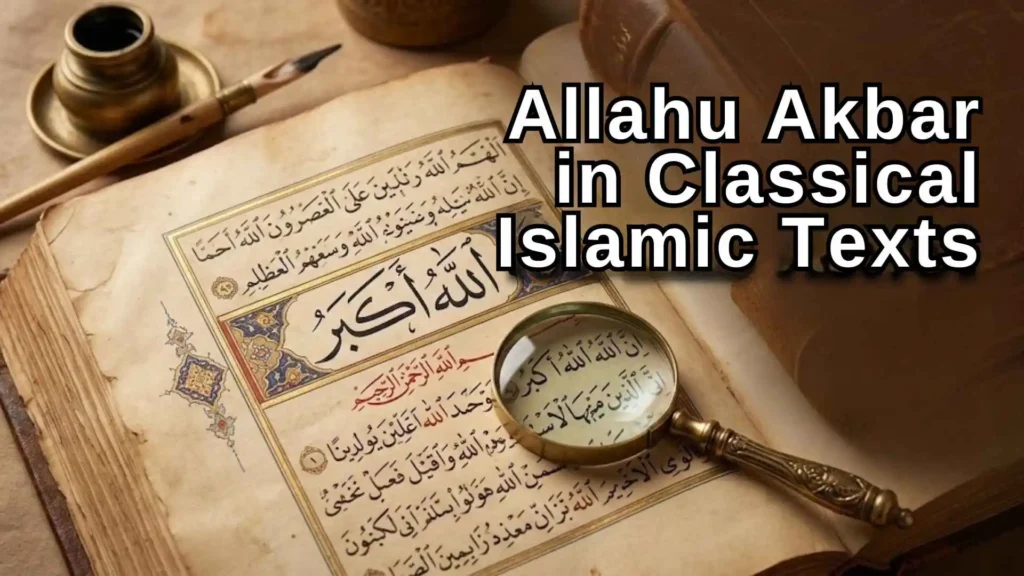
The phrase appears repeatedly in hadith literature, including Riyadh al-Salihin #1409.
In many narrations, the Messenger of Allah ﷺ used the phrase:
- When climbing elevated ground
- When beginning prayer
- In moments of gratitude
It was not a slogan. It was devotion.
Historically, early Muslim communities incorporated it into:
- Worship
- Pilgrimage rites
- Celebratory moments
- Military settings
Even in military contexts, it expressed reliance on God rather than aggression.
Context defines tone.
Allahu Akbar Compared to Other Islamic Phrases
Understanding related phrases adds clarity.
| Phrase | Meaning | Focus |
| Allahu Akbar | Allah is Greater | Supremacy |
| Subhanallah | Glory be to Allah | Perfection |
| Alhamdulillah | All praise is for Allah | Gratitude |
| La ilaha illallah | No god but Allah | Oneness |
Each phrase serves a theological function.
- Subhanallah meaning emphasizes divine flawlessness.
- Alhamdulillah meaning centers gratitude.
- La ilaha illallah meaning declares monotheism.
- Allahu Akbar asserts divine magnitude.
Together, they form a complete spiritual ecosystem.
The Comparative vs Superlative Debate | Greater or Greatest?
Many English translations choose “Allah is the Greatest.”
That translation works. Yet it subtly closes the comparison.
“Allah is Greater” keeps the comparison open.
It implies:
- Greater than wealth
- Greater than political power
- Greater than grief
- Greater than ego
Arabic allows both meanings. Context determines nuance.
From a linguistic standpoint, understanding the ism tafdīl meaning clarifies why both are valid.
Why Translation Alone Is Not Enough
Literal translation captures structure. It cannot capture spiritual weight.
Language carries:
- Cultural memory
- Emotional tone
- Historical continuity
Arabic rhetorical style often omits comparison targets. English rarely does. This difference explains why translation sometimes feels incomplete.
Understanding the Arabic meaning of Allahu Akbar requires stepping into its linguistic world.
Allahu Akbar and the Concept of Divine Greatness
Theologically, the phrase connects to core attributes of Allah:
- The Creator
- The Infinite
- The Sublime
- The One
In Islamic belief, divine greatness is not just physical magnitude. It includes:
- Knowledge beyond comprehension
- Mercy beyond limitation
- Power beyond restriction
- Wisdom beyond human calculation
Thus, when a believer says Allahu Akbar, they affirm:
Divine greatness transcends creation.
This declaration shapes worldview.
Practical Applications | Living the Meaning Daily
Understanding theory matters. Living it matters more.
Here are practical ways Muslims embody the phrase:
- Pause before reacting in anger
- Say Allahu Akbar before beginning a task
- Use it during stress
- Whisper it during hardship
It becomes a habit of perspective.
Example Scenario
You receive troubling news. Your mind spirals. Fear rises.
You say:
Allahu Akbar
Instantly, the focus shifts. The problem remains. Its dominance weakens.
That shift builds resilience over time.
Frequently Asked Questions About Allahu Akbar
Is Allahu Akbar only said during prayer?
No. While central in Salah, Muslims say it in daily life, during celebration, and in personal reflection.
Does Allahu Akbar mean God is the greatest?
Yes, grammatically it can mean that. However, “Allah is greater” preserves the open comparison.
Why do people misunderstand the phrase?
Media framing and political events often isolate the phrase from its devotional context.
Do Arabic-speaking Christians say Allah?
Yes. “Allah” is simply the Arabic word for God and predates Islam.
What is Takbir?
Takbir refers to the act of saying Allahu Akbar.
Psychological Strength and Spiritual Resilience
Faith traditions often emphasize surrender. Islam combines surrender with perspective.
When someone internalizes Allah is greater than hardship, they cultivate:
- Patience
- Hope
- Emotional endurance
- Gratitude
Spiritual resilience grows through repetition.
Think of it like lifting weights. One repetition does little. Thousands reshape strength.
Daily repetition of Allahu Akbar reshapes mental framing.
The Phrase in Global Muslim Life Today
Today, Muslims across continents recite it:
- In Indonesia
- In Turkey
- In Nigeria
- In Pakistan
- In the United States
Despite cultural diversity, the phrase unites believers.
It transcends language barriers. It anchors identity.
This continuity across centuries reflects its permanence.
Final Reflection | What Allahu Akbar Really Means
At its core, Allahu Akbar is not a slogan. It is perspective. It reminds you that no force rivals the Creator. It reframes fear, success, grief, and joy within divine scale.
Understanding what Allahu Akbar means transforms it from a sound into a declaration of hope. When you grasp its depth, you see it for what it truly is: a daily recalibration of the soul.

Ashton Cole is an American author celebrated for his compelling storytelling and ability to capture the depth of human emotions. His works often explore themes of love, resilience, and self-discovery, making him a relatable voice for readers around the world.
He has published several well-received books, including:
-
Whispers of Dawn – a reflective novel about finding hope in life’s darkest moments.
-
Beneath the Silent Sky – a moving story of love, memory, and the bonds that shape us.
-
The Edge of Forever – a thought-provoking tale that blends drama, destiny, and the courage to begin again.
Through his writing, Ashton strives to inspire readers to see beauty in both the struggles and triumphs of life. When he isn’t writing, he enjoys exploring new cities, collecting rare books, and spending time in cozy coffee shops where many of his story ideas take shape.