

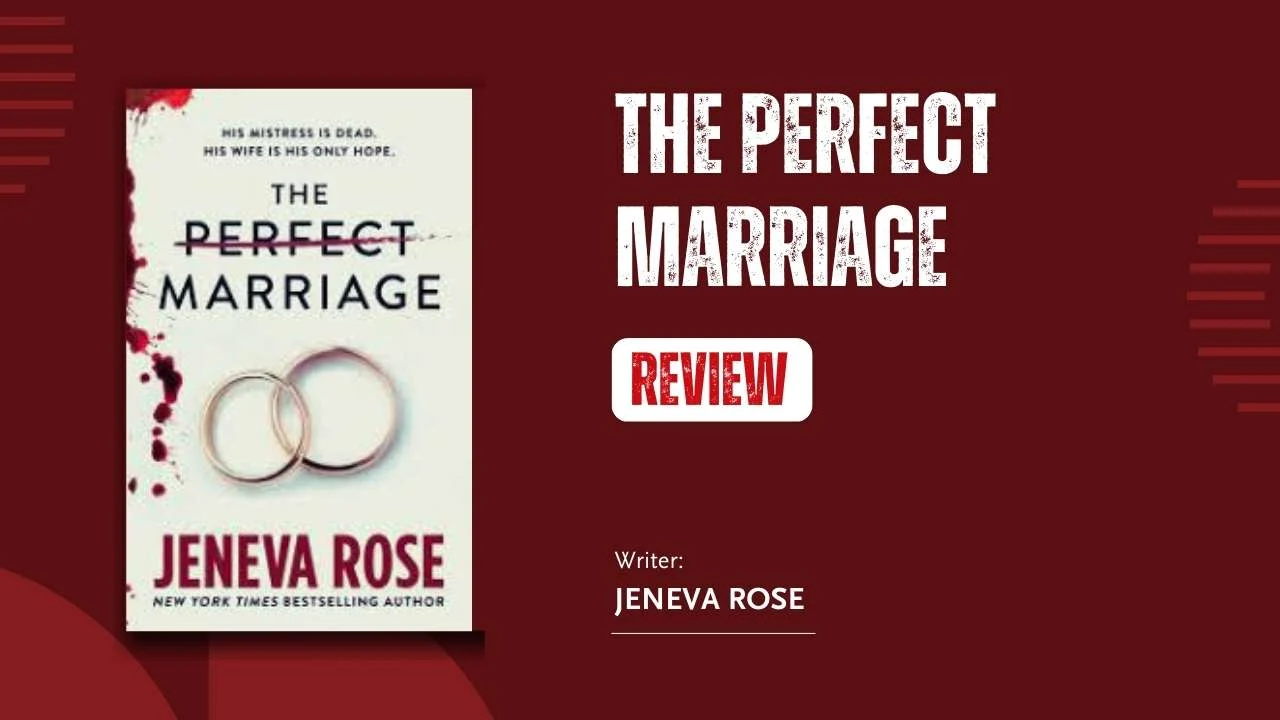
“The Perfect Marriage review” isn’t just about a murder. It’s about power. About control disguised as loyalty.
About how love, when mixed with ego and intellect, can become something dangerous.
Jeneva Rose doesn’t write a cozy thriller here. She builds a psychological trap and invites you to walk straight into it.
This review explores the novel in full depth of characters, themes, twists and uncomfortable truths, so you know exactly what kind of story you’re stepping into.
Book Overview | The Perfect Marriage by Jeneva Rose
- Author: Jeneva Rose
- Genre: Psychological thriller, legal thriller, marriage-based thriller
- Publication Year: 2020
- Format: Standalone novel
- Average Rating: ~4.0/5 across major platforms
The Perfect Marriage by Jeneva Rose centers on a devastating premise:
A successful defense attorney must defend her husband after he’s accused of murdering his mistress.
That single sentence carries the weight of the entire novel. It blends legal thriller mechanics, psychological manipulation, and domestic betrayal into a fast-paced narrative that never pretends to be morally clean.
Spoiler Free Plot Summary | What’s the Story About?
Sarah Morgan is a brilliant defense attorney. She wins cases other lawyers won’t touch. Her husband, Adam Morgan, is a struggling writer whose career never quite takes off.
Their marriage already feels uneven.
Then Adam’s mistress, Kelly Summers, is found brutally murdered at a secluded vacation cabin. Adam becomes the prime suspect. Evidence piles up. Motives stack neatly against him.
Sarah makes a decision that defines the novel.
She will defend him.
Not as his wife.
As his lawyer.
From there, The Perfect Marriage novel becomes a chess match between truth and perception, where every move hides a deeper intention.
Full Plot Breakdown
Once the affair surfaces, the narrative accelerates.
Adam admits to cheating but denies murder. Sarah takes control of the legal strategy, shaping the story the police and jury will hear. Evidence appears damning—Adam was present near the time of death, emotionally volatile, and publicly humiliated.
Yet cracks begin to show.
- Inconsistent testimonies
- Suspicious police behavior
- A hidden connection between Kelly and law enforcement
- Strategic omissions in Sarah’s narration
The biggest twist isn’t who committed the murder.
It’s who controlled the truth all along.
The final reveal reframes the entire novel, forcing readers to revisit earlier scenes with a new lens. What felt like loyalty was calculation. What seemed like love was dominance.
Character Analysis | Motives Matter More Than Morality
Sarah Morgan | The Unreliable Architect
Sarah Morgan stands out among thriller protagonists because she doesn’t seek sympathy.
She seeks control.
- Highly intelligent defense attorney
- Emotionally detached
- Strategic to the point of cruelty
- Fully aware of her power
Sarah embodies the unreliable narrator trope at its sharpest. She tells the truth selectively. She withholds emotional context. She frames events to suit her narrative.
This isn’t accidental writing. It’s deliberate manipulation.
Sarah doesn’t react to betrayal like a wounded spouse. She reacts like a tactician assessing a breach in security.
Adam Morgan | Passive, Dependent, Dangerous
Adam isn’t innocent. But he isn’t powerful either.
- Failing author
- Emotionally dependent on Sarah
- Seeks validation outside marriage
- Avoids responsibility
Adam represents weaponized helplessness. His affair isn’t driven by passion alone but by a need to feel significant. He becomes a pawn in a game he doesn’t understand until it’s too late.
Kelly Summers | The Erased Woman
Kelly Summers begins as “the mistress,” but her role is far more disturbing.
- Lived under an assumed identity
- Connected to law enforcement
- Used and discarded by powerful people
Kelly’s murder exposes how disposable certain women become in male-driven narratives. She isn’t granted depth in death because the system never granted her protection in life.
Supporting Characters With Purpose
| Character | Role | Narrative Function |
| Anne | Sarah’s assistant | Emotional grounding and contrast |
| Bill | Law firm partner | Hypocrisy and moral decay |
| Cop Boyfriend | Kelly’s partner | Police corruption |
| Bill’s Brother | Background victim | Pattern reinforcement |
Each character reinforces the novel’s central message: power shields itself.
Marriage as a Psychological Battlefield
This isn’t a love story.
It’s a power struggle disguised as commitment.
Key relationship dynamics include:
- Emotional abandonment masked as ambition
- Infidelity as rebellion, not romance
- Codependency framed as loyalty
- Control replacing intimacy
Sarah doesn’t need Adam emotionally. Adam needs Sarah existentially. That imbalance poisons every interaction.
The marriage was broken long before the murder.
Psychological Themes That Drive the Story
The Perfect Marriage review wouldn’t be complete without unpacking its core psychological elements.
Gaslighting as Strategy
Sarah reframes events constantly, causing readers to doubt their instincts.
Moral Ambiguity
There are no heroes here. Justice feels optional.
Revenge vs Justice
Punishment isn’t about truth. It’s about balance of power.
Identity Concealment
Name changes and hidden pasts reinforce how easily truth can be rewritten.
Legal Thriller Elements | Realism Meets Manipulation
Jeneva Rose understands courtroom drama.
- Conflicts of interest feel intentional
- Legal loopholes are exploited convincingly
- Defense strategies align with real-world practices
However, the novel critiques the system as much as it uses it.
The law doesn’t protect truth. It protects whoever understands it best.
Police corruption, selective evidence handling, and narrative framing all feel unsettlingly plausible.
Narrative Structure | How the Book Tricks You
This twisty thriller thrives on misdirection.
- Dual perspectives that withhold context
- Red herrings that feel emotionally convincing
- Foreshadowing only visible in hindsight
The reader becomes complicit. You trust the wrong voice. You root for the wrong outcome.
That’s the point.
Pacing, Style and Readability
- Short chapters
- Minimal exposition
- High tension per page
This is a fast-paced thriller designed for binge reading. There’s little filler. Every scene pushes the narrative forward or reframes what you think you know.
The Ending Explained | Why It Divides Readers
The ending lands like a cold slap.
Some readers love it. Others feel betrayed.
Why?
Because the book refuses to reward morality. It rewards intelligence.
The final reveal forces readers to confront their own assumptions about loyalty, gender, and justice. No redemption. No apology. Just consequences.
Strengths and Weaknesses
What the Book Does Well
- Bold female antihero
- Clean, high-concept premise
- Effective psychological manipulation
Where It Falls Short
- Limited emotional depth in side characters
- Predictable beats for seasoned thriller readers
- Ethical discomfort left unexplored
How The Perfect Marriage Compares to Similar Thrillers
Compared to other marriage thrillers and legal thrillers, this novel:
- Prioritizes power over empathy
- Trades emotional catharsis for shock
- Focuses on control rather than healing
It fits comfortably beside modern domestic noir but leans darker in intent.
Who Should Read This Book

Recommended for:
- Fans of psychological manipulation stories
- Readers who enjoy morally gray characters
- Lovers of twist-driven narratives
Not ideal for:
- Readers seeking emotional closure
- Those sensitive to betrayal themes
- Fans of clear moral resolution
Frequently Asked Questions
Is The Perfect Marriage based on a true story?
No. It’s entirely fictional but grounded in realistic legal and psychological dynamics.
Is Sarah Morgan a villain or antihero?
She’s an antihero with villainous traits. The book refuses to label her.
Is the ending predictable?
Some twists may be guessed, but the final reveal reframes earlier assumptions.
Is this more psychological or legal thriller?
It balances both but leans heavier into psychological manipulation.
Does the book glorify infidelity?
No. It presents infidelity as destructive leverage, not romance.
Is there a sequel?
No direct sequel connects to this story.
Conclusion
The Perfect Marriage is unsettling by design. It doesn’t comfort. It confronts. Jeneva Rose delivers a sharp, controlled narrative that values intelligence over likability and power over morality.
If you enjoy thrillers that leave you uneasy and questioning your own judgments, this book earns your time. Just don’t expect forgiveness at the finish line.
Read More:
- https://anniversiry.com/is-the-perfect-marriage-based-on-a-true-story/
- https://anniversiry.com/the-perfect-marriage-ending-explained/

Ashton Cole is an American author celebrated for his compelling storytelling and ability to capture the depth of human emotions. His works often explore themes of love, resilience, and self-discovery, making him a relatable voice for readers around the world.
He has published several well-received books, including:
-
Whispers of Dawn – a reflective novel about finding hope in life’s darkest moments.
-
Beneath the Silent Sky – a moving story of love, memory, and the bonds that shape us.
-
The Edge of Forever – a thought-provoking tale that blends drama, destiny, and the courage to begin again.
Through his writing, Ashton strives to inspire readers to see beauty in both the struggles and triumphs of life. When he isn’t writing, he enjoys exploring new cities, collecting rare books, and spending time in cozy coffee shops where many of his story ideas take shape.